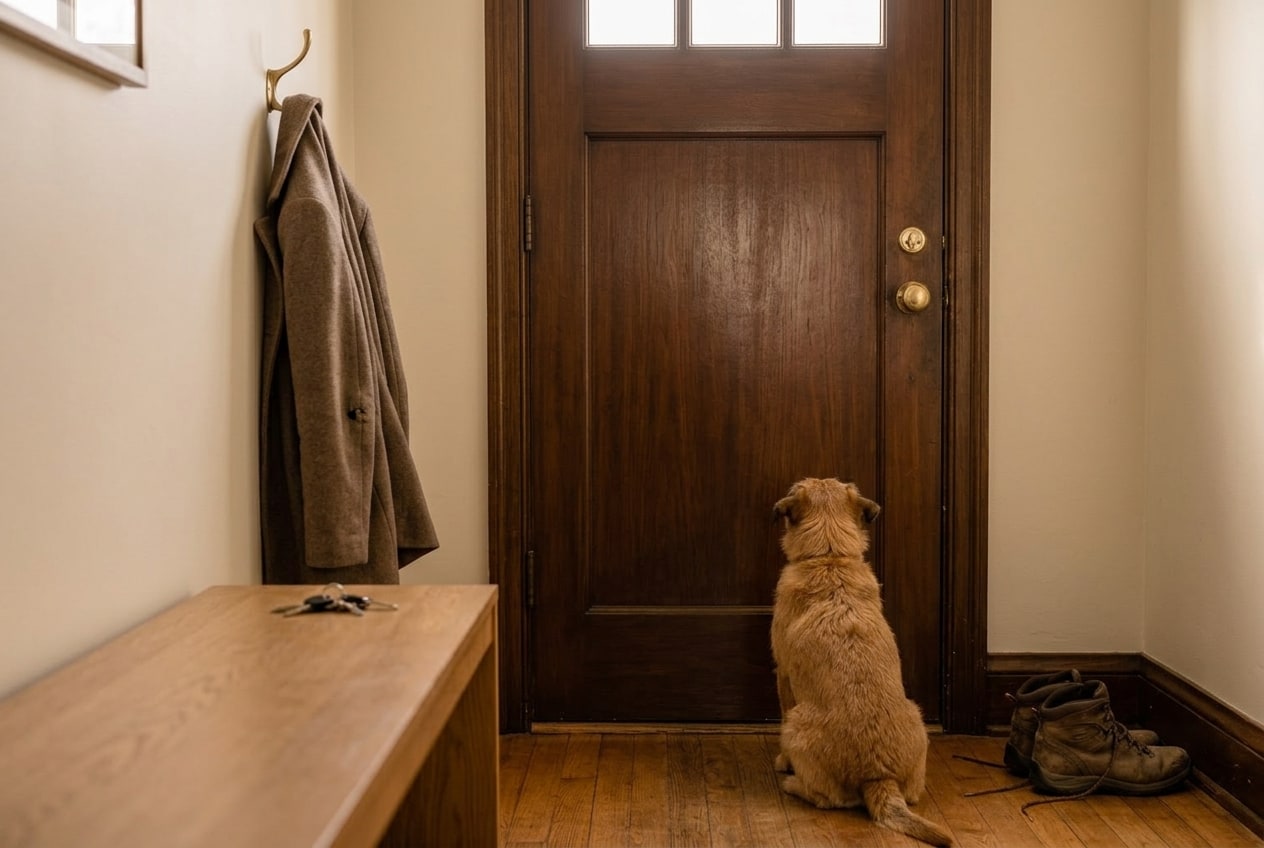
A greeting ritual is the household choreography that fires when a member of the household walks through a door. It runs for less than a minute. It looks the same every time. The dog knows the sound of the car before the neighbors do. The choreography is old, older than any specific household, and it is doing measurable work.
What we mean by a greeting ritual
The Journal uses greeting ritual to name the compressed sequence of small acts a household performs when its members reunite. The keys hit the mat. The door swings inward. The dog is already there, whines coming up in pitch, tail set at the exact frequency the household reads as you are home. The human puts the bag down, kneels, offers a syllable of the dog's name. The cat comes down the corridor at half the speed, tail up, and rubs the human's shin twice. Fifty seconds later everyone in the house is back to what they were doing.
The choreography does not have to be spectacular to count as ritual. The word matters. A greeting is a one-off exchange. A greeting ritual is a pattern the household has settled on, tacitly, across months or years, and now performs without thinking about it. Rituals are legible from the outside; any visitor who has been in the house twice can predict how the dog will greet them on the third visit.
Ritual is different from habit in a specific way. Rituals carry meaning the participants have not been asked to name. The greeting ritual is the household's daily statement that the household has re-formed. The bag on the mat is the ritual object.
The oxytocin loop and its limits
The greeting ritual is chemical as well as sentimental. It is, in a specific measurable sense, both.
A 2015 study by Miho Nagasawa and colleagues in Science found that when dogs and their humans held prolonged mutual gaze in a 30-minute interaction at home, urinary oxytocin rose in both species, with the strongest effect concentrated in the dyads that held the longest gaze episodes. A second experiment in the same paper administered intranasal oxytocin to dogs, and the dogs subsequently gazed longer at their owners, who in turn showed elevated oxytocin. Nagasawa's team interpreted the finding as evidence that the dog-human bond has co-opted a mammalian bonding circuit (the same peptide that anchors mother-infant attachment) through domestication. The paper's title names the effect: Oxytocin-gaze positive loop and the coevolution of human-dog bonds.
Two limits are worth naming. Nagasawa's finding is a correlation from a specific experimental design, and it is a claim about the interaction, not any single greeting; the greeting ritual is one channel by which the loop is fired, and there are others. The cat literature runs on its own track. Domestic cats produce their own affiliative behaviors on their own schedule, only partly overlapping with the dog research.
Held lightly, the science does one useful thing. It confirms what the household already knew. The daily greeting ritual is doing measurable work in the reunion, and the reunion is doing measurable work in the daily household.
The rest of this essay is about what the household already knows.
The choreography, house by house
Greeting rituals vary. The specifics are the household's; the shape recurs. A rough taxonomy from the Journal's working notes:
| Ritual type | The household's role | The companion's role | Duration |
|---|---|---|---|
| The threshold sequence | Puts bag down, kneels, offers the name | Meets at the door, whines rising in pitch, presents shoulder | 30-90 seconds |
| The controlled greeting | Waits until the dog sits before reaching for them | Sits (usually), licks the wrist, then follows to the kitchen | 60 seconds |
| The delayed acknowledgment | Removes coat first, greets from the middle of the room | Watches, tail low but wagging, waits for eye contact | 90-120 seconds |
| The silent reunion | Puts a hand on top of the cat's head without speaking | Rubs face into palm twice, walks away, returns from a new angle | 20-40 seconds |
None of the four is more correct than any other. Households settle into the ritual that fits their traffic and their species. The ritual persists because it works for the household, and it works because the household repeats it exactly.
For context on how common the underlying relationship is: the American Veterinary Medical Association's 2024 pet ownership survey reports 66% of US households own a pet, and Pew Research's 2023 study found 51% of US pet owners consider their pet to be as much a part of the family as a human family member. A daily greeting ritual, in half of these households, is a family reunion.
What the ritual is actually doing
The functional read, for the writer or editor working on a keepsake, is that the greeting ritual is a compressed statement of what the household is. Everyone in the household has a role. Everyone knows the cue. The ritual restarts the household's shared time each evening, and closes the small gap the day opened.
For the human, the ritual returns the day to a smaller scale. The dog waiting at the door does not care about the afternoon meeting. The cat coming down the corridor is indifferent to the email. The reunion resets the household's clock to the household's own rhythm.
For the animal, the ritual seems to answer a specific question: is the household re-formed? Dogs, in particular, appear to keep track of who is present with something like a running tally. The tail set at the correct frequency is, in that reading, the dog closing the tally back to full.
In sixty seconds the household closes the tally the day opened.
The ritual is small. It happens a thousand times over a decade. It is the shape of the daily relationship, compressed into the sixty seconds the household walks through the door.
A short guide to writing greeting rituals into a keepsake
For writers and editors composing pet keepsakes, the greeting ritual is a first-order candidate for a scene. It is character in compressed form. The rules the Journal has settled on:
- Name the specific choreography. He waits at the door is a caption. He waits at the door with his shoulder pressed to the doorframe so the door hits his shoulder first when it opens is a character.
- Include the household's role. The greeting is a two-party act. Write the human's kneeling, the human's exact syllable, the exact hand placement. The reader should see both bodies in the ritual.
- Use present tense for the ritual. The ritual is continuous. It happened yesterday, it will happen tomorrow. Present tense is the tense the ritual lives in. See why we write pets in the present tense for the argument at length.
- Skip the interpretation. The reader will make the meaning. Write the choreography plainly and trust the reader to feel the reunion.
- Choose the ritual most specific to the household. Every household has a repertoire. The one worth writing is the one no other household would perform in exactly that order.
The greeting ritual, done well on the page, is the sentence a household reads and recognizes as their own kitchen.
The closing
The greeting ritual is a small daily act with an unreasonably large emotional footprint. The science confirms a fragment of what the household already knew. The choreography persists because it is the household's own signature, refined across months of practice, held together by both parties without either party naming what they are holding.
The Journal is interested in these compressions. A pet's whole character often lives in three small daily rituals: the greeting, the feeding, the goodnight. Any keepsake worth keeping catches at least one of them plainly. For the wider editorial argument on writing pets as characters, see the difference between a character and a caption and what is a personalized pet storybook. For the pillar this satellite sits within, see living with a companion, a reading list.
The dog is at the door. The cat is halfway down the corridor. The household is re-forming. Everyone knows the sequence.