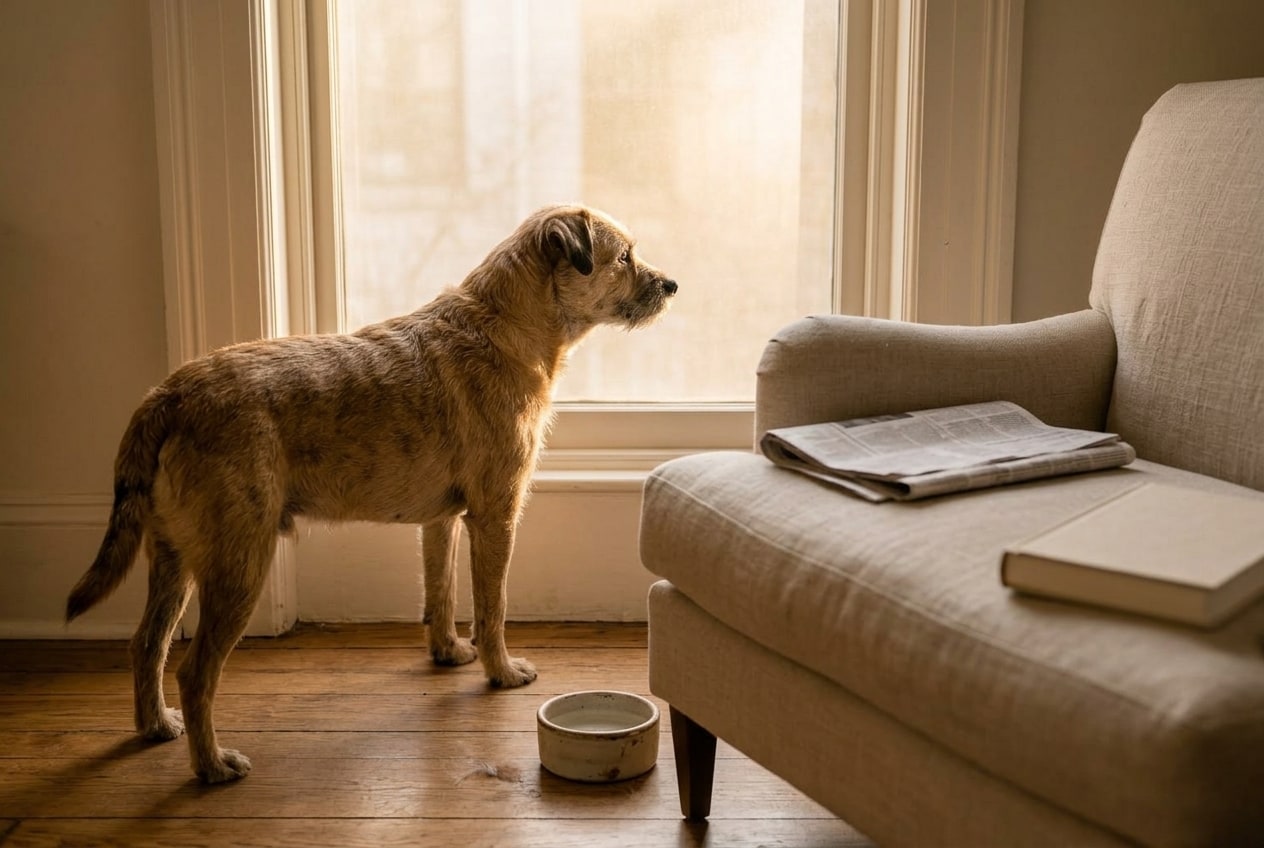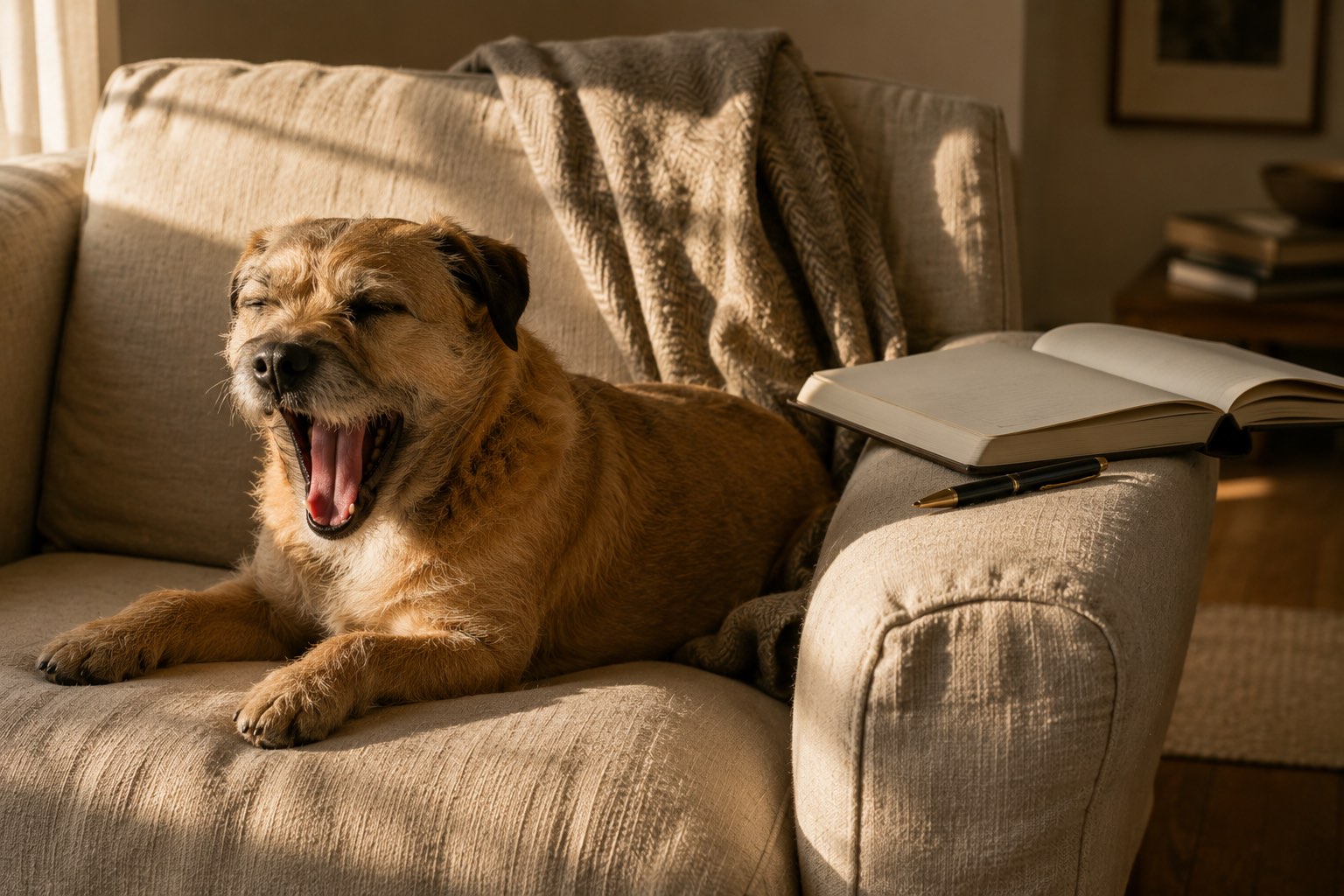
A caption tells you what is in the frame. A character lets you stand in the room. The editorial gap between them is the work a keepsake book either does or does not do. When the page treats a companion as a character, the reader who never met the dog leaves the page feeling they have.
The distinction matters because the household commissioning a keepsake is, almost always, the household that has already lived with this dog or cat for years. The page is keeping a record of someone the reader already knows. The work the prose has to do is recognition; the household is the audience, and the new information is rarely factual. A caption-only book risks reminding the household of facts they could have written themselves on the back of a photograph. A character-driven book gives them an account of a companion they thought they already knew completely, and finds something in him they had not put into words.
What a caption does
A caption identifies. It tells the reader who and where and when. Mabel, age four, at the back gate. Henry on the sofa, July 2023. The form is honest and useful. It does its job in fewer than ten words and asks the reader to do the rest of the work themselves.
A caption is structurally limited by what a photograph can show. The reader sees the dog. The caption confirms the dog's name and notes the room. The relationship between text and image is naming, which is one of the older jobs language does and a good one. The album of family photographs uses captions. The photograph above the mantel uses one. The keepsake's table of contents and its credits page both use captions, and the book is better for them.
The trouble starts when a book sold as an editorial keepsake reads, page after page, as a series of captions. A caption-only book is, structurally, a photo album that has been priced as a keepsake. The household pays for prose and receives identification.
What a character does
A character makes the page hold someone the reader can recognize. The reader knows what the dog wants, what he refuses, the small habit he keeps that nobody asked him to keep. Character writing carries interior life onto the page without claiming to read the animal's mind.
The work is specificity. Henry waits at the door at half past three because the school bus passes the corner then and the children sometimes come down the path with biscuit crumbs in their pockets. The sentence does five things at once: names the dog, names the time, names the place, names the cause, and names the household. The reader leaves the sentence knowing Henry the way the household knows him.
Character writing is also restraint. The page does not tell the reader Henry is loyal or sweet or the best dog in the world. Those words belong to the household, said aloud at the kitchen table, and the editor's job on the page is something else: find the sentence about the biscuit crumbs and let the reader's word for Henry be the word the reader chooses.
The editorial register most resembles a magazine profile of a person the reader has not met. The profile writer chooses the small accurate observations that compound into a sense of someone in the room. A character profile of a dog uses the same instrument, with the editorial discipline of leaving the conclusions to the reader.
Side by side: the same dog, two registers
The clearest way to read the difference is the same dog, treated as a caption and then as a character.
As a caption:
Henry, golden retriever, age seven. Lives in a two-bedroom flat with one human, a postman with a long walking route. Loves the park.
As a character:
Henry is the dog the postman brings home at the end of the long walking route, ears warm and feet cold. He waits at the kitchen door when the kettle clicks. He has decided the second piece of toast belongs to him and waits for his human to make the second piece without ever asking for the first. The park is one of his rooms. The flat is another.
Both passages give the reader the same facts. They make a different book.
The caption version sits flat. It is true and forgettable. The character version runs longer because each clause is doing a job the caption version asked the reader to do alone. Ears warm and feet cold tells the reader Henry has been outside for a long time and is now indoors. Waits at the kitchen door when the kettle clicks tells the reader Henry has a daily relationship with the household's small rituals. Has decided the second piece of toast belongs to him tells the reader Henry is a particular dog with a particular history.
A household keepsake belongs in the second register. The book is being read by the household that already knows Henry, and the second passage will be the one the household reads aloud at the kitchen table for years, because it sounds like the dog they live with.
A short method for moving from caption to character
For writers and editors working on keepsake prose, the four moves that turn a caption into a character:
- Name a specific habit, not a general trait. Replace loves the park with trots to the corner of the field that smells of rabbits and stops there until pulled away. The general trait is the photograph's caption. The specific habit is the dog.
- Locate the dog in a household, not in a species. Replace golden retrievers are friendly with Henry greets every visitor at the door and then loses interest about ninety seconds in. The species is generic. The household is particular.
- Let one small object do the work of a sentence. The second piece of toast. The squeaky duck whose squeak has worn out. The corner of the rug that is now permanently the dog's corner. Objects are character compression; the household recognizes itself through them.
- Trust the reader to draw the conclusion. Write the four sentences from which a reader will, on their own, decide Henry is a sweet dog, and trust them to do the deciding. The reader's verdict is more durable than the writer's.
These four moves are the working substance of character prose. They are also the moves a household photograph asks for in parallel; see photographing the pet you live with for the photographic version of the same discipline.
Where the caption belongs
A craft rule that admits no exceptions is dogma. The keepsake form admits captions in three places, and the editorial discipline is knowing them.
The first place: the table of contents, the credits page, the photo cutlines that accompany an image-led spread. A caption that runs four words under a photograph keeps the reader's eye in the image and gets out of the way.
The second place: any scene the household specifically asked the editor to record literally. An adoption date, a vet's note, the name of the rescue, the city where the dog was found. The household sometimes wants a fact preserved exactly, and the keepsake book honors the request with a caption.
The third place: the inside-cover dedication or the closing colophon, where the register shifts away from narrative and toward the bibliographic. A caption here grounds the book in time.
The body of the book sits outside the caption's range. The pages between the dedication and the colophon are where character writing lives, because they are the pages a household reads.
The working test
A test the Journal uses on every keepsake draft: read a page aloud to someone who has never met the dog. If the listener finishes the page and can describe the dog back to you in three or four specific details, the page is doing character work. If the listener can only repeat the dog's name and breed, the page is caption work in editorial clothing.
Pew Research's 2023 study on US pet ownership found that 51% of US pet owners consider their pet to be as much a part of the family as a human family member. A book about a member of the family deserves, at minimum, the prose register a profile of a family member would call for. The keepsake book that meets the bar is the one a household keeps. The keepsake that falls short, the household quietly retires after the first reading.
A caption gives the reader a fact. A character gives the reader a recognition.
The editorial work of writing a companion onto a page is the work of choosing, sentence by sentence, the register the household will recognize as their own. Heavy paper, on its own, will not save a caption-only book; see the case for the eighty-pound page for the material argument. The voice on the page is what carries the household's recognition. For the wider editorial argument on tense in keepsake writing, see why we write pets in the present tense. For the category context of these books, see what is a personalized pet storybook.
The dog the household lives with is already a character. The page either treats him as one or treats him as a label. The whole craft is the choice.