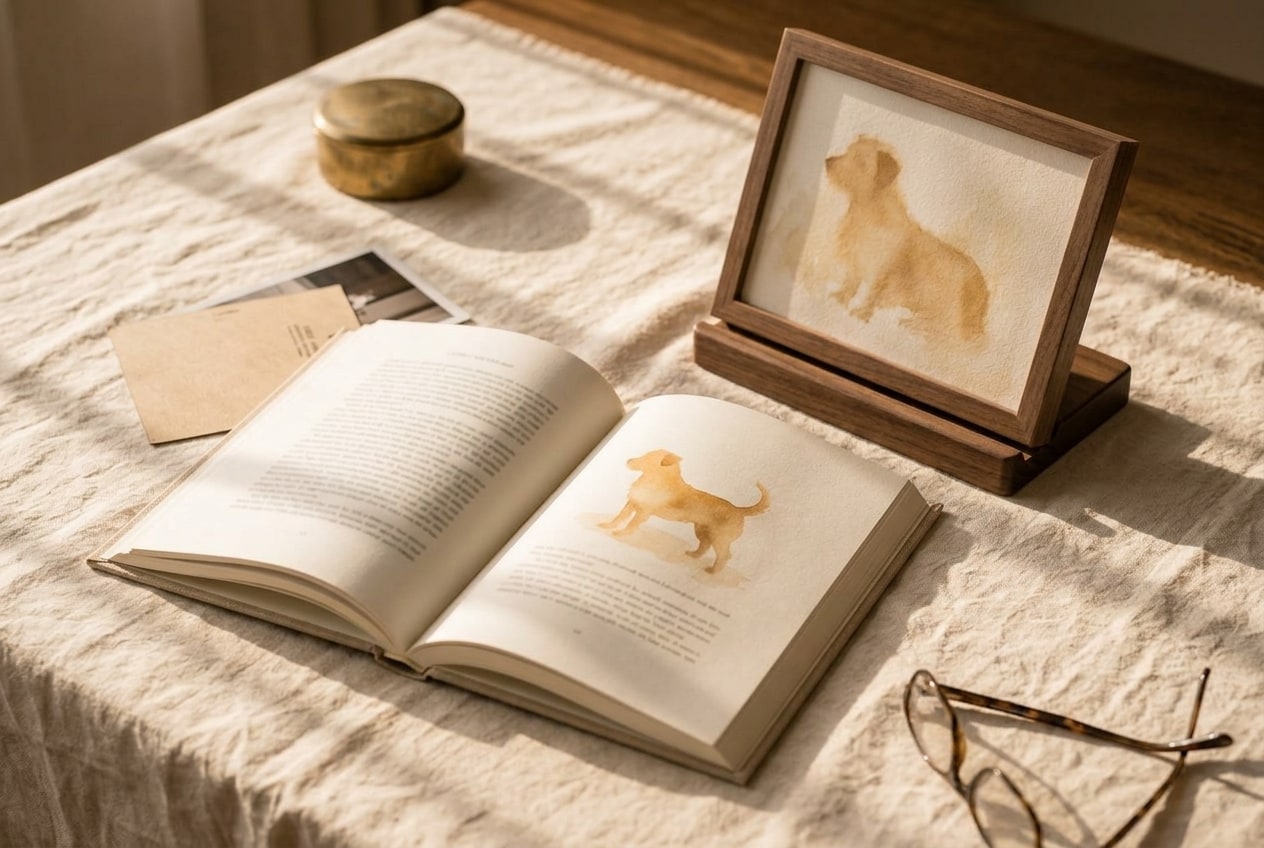
A personalized pet storybook is an illustrated book that treats a specific dog or cat as the main character, with the prose, the scenes, and the bound object built from a household's own photographs and details. It sits in a category of its own, separate from photo albums, portrait commissions, and personalized children's books. Its quiet rise tracks a real shift in how households think about the pets they live with.
Where the category came from
Personalized books for children have been a small but durable category for decades, with the modern wave beginning around the 2014 launch of Wonderbly's Lost My Name, which has sold more than 4 million copies and is now part of Penguin Random House. The format was simple: a child's name and likeness woven into a printed narrative the child could read with a parent.
The pet-adjacent shift came later. Households with pets, especially Millennial and Gen Z households, started looking for objects that gave their companions the same editorial dignity. The American Veterinary Medical Association's 2024 pet ownership survey reports that 66% of US households own a pet, and Pew's 2023 pet ownership study found 51% of pet owners treat their pet as much a part of the family as a human family member. The market for a book that takes the pet seriously, in the way a magazine takes a profile subject seriously, follows from that shift.
The first wave of personalized pet books took the children's-book template and substituted a pet for the child protagonist. The form worked in its own way. A second wave, of which Pets & Pages is part, treats the pet as a literary subject in their own right: editorial prose, lifelike scenes, materials a small press would commission. The category is now wider than its first form, which is partly why a clean definition is useful.
How a personalized pet storybook is different from adjacent things
The buyer for a personalized pet storybook often arrives by way of an adjacent category and discovers that the object they actually wanted does not exist at any of the obvious stops. The simple way to read the landscape:
| Adjacent category | What you get | What's missing |
|---|---|---|
| Personalized children's book | A narrative aimed at children, with a child protagonist and a rhyming register | A pet as the main character, written for a household that lives with the pet |
| Photo book | A blank album you fill with your own photographs | A composed narrative, illustrated scenes, an editorial voice on the page |
| Commissioned pet portrait | A single illustrated or painted image of the pet | A book: pages, a binding, prose, multiple scenes, the physical object of a small press |
| Pet memorial keepsake | A tangible keepsake object such as an urn, paw print, or custom jewelry | A reading experience, something a household opens again and again |
| Generic AI pet book | A quickly-generated illustrated story, usually at a low price point and a kid-friendly register | Editorial-quality prose, print materials at heirloom tier, an adult register |
The format-defining quality of a personalized pet storybook is the combination of three things at once. The pet is the subject. The prose is composed. The object is bound and printed at print-craft tier. Remove any one of the three and you are in a different category.
What the buyer is actually choosing
A household buying a personalized pet storybook is making three smaller choices folded into one decision.
The first choice: narrative versus single image. A commissioned portrait gives you one frame. A storybook gives you a sequence: opening, middle scenes, closing reflection, with a voice that runs through them. A household that wants a single beautiful image to hang on a wall is choosing the portrait commission. A household that wants something to read aloud is choosing the storybook. (See our notes on photographing the pet you live with for the photo-selection question that follows.)
The second choice: register. Some personalized pet books are children's books with a pet swapped in. Others are written in an adult editorial register, the cadence of a magazine profile. The household's intended reader settles which is right. A book composed for a six-year-old reads differently than a book a household reads aloud in its own kitchen, and the same illustration style rarely serves both ends.
The third choice: object tier. Print-on-demand books range from cheap-and-fast disposables to small-press hardcovers built to last decades. The difference shows up in paper weight, binding type, cover treatment, and ink quality. (See the case for the eighty-pound page for the material argument, and the difference between a character and a caption for the writing-quality argument.)
These three choices, made at the same time, define the book the household actually wants. Most buyer disappointment in this category traces back to one of the three being misaligned.
What "good" looks like
A working benchmark for editorial-tier personalized pet storybooks rests on five qualities, each of which is independently observable when the book arrives:
- The prose treats the pet as a character. The voice on the page sounds like someone who knows the specific dog or cat. Names appear naturally. Habits are particular. The book has been written rather than templated.
- The illustration is lifelike and editorial. The scenes look like photographs the household might have taken on a different afternoon. The pet looks like the pet rather than a clip-art rendering of the species.
- The book is bound at a print-craft tier. Heavy paper that holds weight in the hand. A binding that lies flat for reading aloud or sits as a small monograph on a shelf. A continuous cover that treats the artifact as a single composed object.
- The text is reviewed by the household before the book prints. The narrative is the household's own. The editorial voice assists; the final words rest with the people who lived the story.
- The format choice fits the reading life. A book a child reads at bedtime asks for a coil-bound softcover that lies completely flat. A book on a shelf asks for a casewrap hardcover. Both are correct; the right choice depends on the household's use.
A book that meets the five becomes the kind of object that a household keeps, opens, reads aloud, and passes between rooms. A book that meets only one or two becomes the kind of object that ends up in a drawer.
A short glossary
The category's language is still settling. Useful working definitions:
Picture book A printed children's book in which illustration carries most of the storytelling weight. Picture books are usually 32 pages and aimed at readers under eight.
Illustrated book A book in which illustration accompanies prose without dominating it. Adult illustrated books are usually 80-200 pages with editorial-style art.
Personalized book A book in which the protagonist or content is customized to a specific reader, household, or subject. The category includes personalized children's books, personalized wedding albums, and personalized pet books.
Photo book A printed book composed of the buyer's own photographs, usually with minimal accompanying text. Photo books are templates the buyer fills.
Personalized pet storybook A printed illustrated book in which a specific household's pet is the protagonist. Prose, scenes, and bound object are built from the household's photographs and notes. May be aimed at children, at adults, or at the household as a whole.
Editorial keepsake A subgenre of personalized pet storybook composed for a household that wants to read about the pet repeatedly, often when the pet is no longer in the room. (See why we write pets in the present tense for the editorial argument on tense in this register.)
Print-craft tier A working term for personalized books printed on heavy paper, with casewrap or coil binding, at the materials standard a small press would commission. Roughly distinguishable from cheap-and-fast print-on-demand by paper weight, binding integrity, and color fidelity.
Why the category exists now
A category appears when three conditions arrive at the same time: a household need, a production economics that supports it, and a writing/illustration toolset that makes the editorial work feasible at single-household scale.
The household need has been building for two decades. Pet-keeping is now characterized by the language of relationship rather than the language of ownership. Cooper Center and Pew studies in the early 2020s found pet owners describing their dogs and cats in terms previously reserved for children and partners. The market followed. In 2024 the APPA reported US pet industry sales of $147 billion for 2023, up from roughly $50 billion in 2010. A book that takes a pet seriously is a household-need product, not a novelty.
The production economics came online in stages. Print-on-demand operations such as Lulu, Blurb, and Mixbook made small-edition hardcover printing accessible to non-publishers in the 2010s. Lulu Press alone has printed more than 2 million unique titles since opening in 2002. The unit economics of a single-household book moved from prohibitive to ordinary.
The editorial toolset came online most recently. Large language models with usable creative writing register, paired with image generation models that can produce scene-grade illustration, allow a small press to compose a household-specific narrative in hours rather than weeks. The combination, when handled with editorial discipline, makes the personalized pet storybook feasible at the price tier a household will actually pay.
None of the three on their own would be enough. The pet humanization shift without affordable POD would still mean small-press hardcovers cost $500. POD without LLM/image tooling would still mean a household had to hire a writer and illustrator at hundreds of dollars an hour. LLM/image tooling without the household-need shift would mean the books had no audience. The three together make a small category possible.
Who buys these books
The category buyer falls into one of a few recognizable shapes, and the shape determines which book in the category is right.
The household composing for itself. Adopting a pet, marking an adoption anniversary, capturing the years before a senior dog's body starts to slow. The household is the reader. The book is intended to be opened repeatedly. Editorial-tier hardcover with adult register; budget usually $70 to $120.
The household composing for its child. A bedtime book about the family dog or cat, with the child as a secondary character. Kid-register storybook, often softcover for lap-reading; budget usually $30 to $55. The mid-mass tier serves this buyer well.
The gift buyer for a friend's pet. A holiday or birthday gift for a friend, family member, or coworker whose dog or cat is central to their household. The gift buyer wants the recipient to feel seen. Editorial tier serves this well; the gift is more meaningful at the print-craft tier than at the disposable tier.
The gift buyer for a household marking a quiet milestone. An older companion. An adopted senior. A first holiday in a quieter house. The gift register matters here; the book should sound like the household at its kitchen table rather than the local paper at goodbye. (See why we write pets in the present tense for the editorial argument on tense in this register.)
The keepsake commissioner. A household commissioning a book about a specific pet whose role in the household is being marked rather than narrated forward. The keepsake register asks for a quieter palette, present-tense voice, and an editorial hand willing to write the book without resorting to the conventions of memorial writing.
Each of these buyers wants something slightly different. A useful first question for any seller in the category, and a useful question for any buyer considering one of these books, is which of the five shapes applies. The answer settles the register, the format, and the price tier.
How to read the price tier
A useful first cut. Pricing in the category is bimodal, with very little in the middle.
- $8 to $25. Mostly digital PDFs or thin print-on-demand softcovers, kid-register, generated quickly, often using lighter AI tooling. Acceptable for a casual gift; rarely an object the household opens repeatedly.
- $30 to $55. The mid-mass tier. Hardcovers, more polished templates, often with illustration that hides the AI involvement. Solid for a holiday gift to a casual pet household.
- $55 to $110. The print-craft tier. Editorial-grade hardcovers on coated stock, considered binding, an adult register where it suits. The book is intended as an object the household keeps.
- $200 and up. Hand-bound or fully custom commissions, often artist-led. Outside the editorial small-press category and into bespoke craft.
Most households buying a book they intend to keep are looking at the $55 to $110 band. Most households buying a holiday gift for a friend's pet are looking at the $30 to $55 band. Both choices are valid; conflating them is where buyer regret usually starts.
A note on multi-pet households
Households with more than one pet have a small additional decision to make. The choice is between a single book that profiles the pair (or the trio) as a household, and separate books for each animal. The first reads as a family portrait. The second reads as a set of individual profiles. Both are valid; the household's reading habit settles which fits.
A single combined book asks the writer to carry two or three voices through one narrative, which works best when the pets share a household rhythm: the cat on the kitchen counter while the dog waits for the walk; the two senior dogs who sleep at opposite ends of the same sofa. A set of separate books asks the writer to treat each pet as their own subject, which works best when each animal has a markedly different relationship with the household. (See books for more than one companion for the editorial argument on composing a profile of a pair.)
The pricing implication is straightforward: a household choosing the combined-book route pays for one book. A household choosing the separate-books route pays per pet.
A note on the form
Personalized pet storybooks, at their best, are small editions of one. They sit in the same shelf neighborhood as a wedding album, a small-press chapbook, a school yearbook. The economics of single-copy printing make them possible at the scale of a single household, and the editorial discipline of taking the pet seriously makes them worth keeping.
The category is wide enough to include cheap-and-fast titles for children and slow editorial volumes for adults. A household buying one of these books deserves to know which version they are getting, and why. The five qualities, the price-tier reading, and the buyer shapes above are a working start.