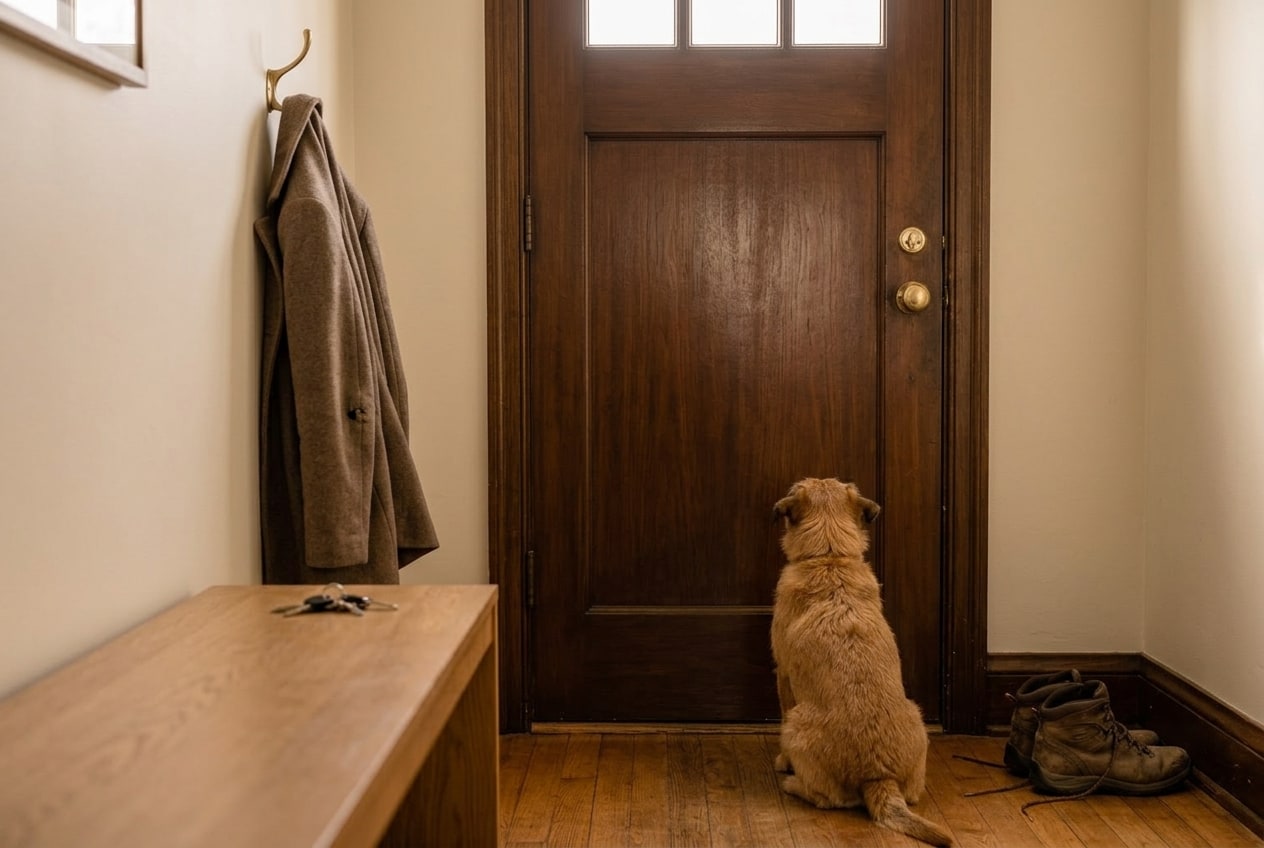
A reading list for living with a companion is a working canon: the books a household can return to when the question is how to think about, write about, or simply sit with the cat or dog at the kitchen door. The list below names nine titles the Journal returns to, with notes on what each carries that the others do not.
What this list is for
Most pet writing sits in three places: the breed manual, the training guide, the social-media caption. Each of these has its uses, and each leaves the literary question of the companion untouched. The breed manual describes what a beagle is; it does not say what it is like to live with one. The training guide explains how to teach a recall; it does not name what the household is recalling. The caption labels the moment.
The reading list below addresses a different question. What is it to live with a companion who watches the household with her own attention, who organizes her day around the household's rhythms, who notices the post arriving and the kettle boiling and the front door at six? The writers below have spent years on that question. The Journal returns to them because they have answered it with the care a household actually feels.
A household composing a book about its own dog or cat will find something usable in each entry. A writer working on a pet for editorial pages, or composing prose for a keepsake at this press, will find a working register. A reader who keeps a dog or a cat and has wanted, once or twice, to read something honest about the experience of doing so will find that the literary canon has been quietly building one. (See why we write pets in the present tense for the Journal's argument on the editorial register that follows from these readings.)
Nine books that take a companion seriously
Virginia Woolf, Flush: A Biography (1933)
A short novel framed as the biography of Elizabeth Barrett Browning's cocker spaniel, narrated in close third person from a position somewhere between the dog's nose and the household's gossip. Woolf wrote Flush between The Waves and The Years, and it is the lightest book in her output, but the seriousness is real. She gave the dog a coherent interior life, an attention to smell as a literary medium, a relationship with the household that the reader recognizes from her own years with the Bell family terriers. The book founded a form: the small, serious literary biography of a dog. The household reading it now will find that the prose has aged better than its reception did in 1933, when reviewers treated it as a Woolf miscellany. Flush is the working starting point for any writer who wants to treat a companion as a literary subject without slipping into anthropomorphism on one side or condescension on the other.
J.R. Ackerley, My Dog Tulip (1956)
Ackerley was the literary editor at the BBC's The Listener for two decades, and his memoir of his Alsatian, Tulip, is the most candid English-language book about a household dog ever written. The candor is the point: Ackerley describes the seasons and routines of living with a particular dog with no editorial sentiment and a great deal of editorial precision. The result is a book that earns the household's trust on the first page and keeps it across two hundred. My Dog Tulip is the book that shows the writer what specificity does. A household trying to write about its own dog should read Ackerley first, then write a sentence, then read Ackerley again.
John Steinbeck, Travels with Charley: In Search of America (1962)
Steinbeck's late road book is a travelogue with a poodle. Charley, a standard poodle blue, accompanies Steinbeck on a circular drive across the United States in a custom camper. Charley sits inside the essay as a structural device, an observer Steinbeck observes observing; he holds the book together without performing as its protagonist. The household reading the book learns how a companion can share a long piece of writing without dominating it: the dog moves through the scenes, registers what the writer is too close to register, and quietly carries the book's emotional weather. The form is useful for any household composing a book in which the pet shares the household's life with other subjects rather than crowding them out.
Elizabeth Marshall Thomas, The Hidden Life of Dogs (1993)
Thomas, an anthropologist who trained on the Ju/'hoansi people of the Kalahari, turned the same patient ethnographic eye on the husky pack she kept in Cambridge, Massachusetts. The book proposes that dogs have an interior social and emotional life of their own, observable through long, undirected attention. Thomas spent years following her dogs on their own paths, taking notes the way she had once taken notes in the desert. The book is loved by households who have always suspected that their dog's day is more organized than the literature suggests. It is also instructive for any writer trying to bring a companion onto the page: Thomas's method is to watch first and to interpret only after the watching has made the interpretation inevitable.
Mark Doty, Dog Years (2007)
Doty is a poet, and the prose memoir he wrote about his two retrievers, Beau and Arden, is the most considered American book on living daily with dogs. The book follows the household across a decade in New York and on Cape Cod, and the writing holds a tone the genre rarely achieves: serious, lyrical, attentive to the dog's specificity and to the household's, never reaching for the easy emotional move. Almost two decades after publication, Dog Years remains the working model for any writer trying to compose a long book about a household dog. A household considering its own keepsake book will read Doty and learn the cadence of a sentence that loves a particular animal without softening into cliché.
Alexandra Horowitz, Inside of a Dog: What Dogs See, Smell, and Know (2009)
Horowitz, a cognitive scientist at Barnard College, wrote the book that turned canine cognition into a household subject. Inside of a Dog is a science book composed for the household, and the writing is unusually careful: every observation is grounded in the literature, claims about what the dog perceives carry a clear note about what the science does and does not show, and leaps of interpretation are flagged as such. The book gives the writer the vocabulary for what the dog is actually doing on the kitchen floor. A household composing a book about its own dog will find that the small, accurate details from Horowitz's research lift the prose toward the same register the science holds.
Mary Oliver, Dog Songs (2013)
Oliver's book of poems about her dogs is the only volume on this list a household can read aloud at a single sitting. The poems are short, specific, and tuned exactly to the register a household uses when it is at its best with its own dog. Dog Songs is Oliver working at the upper end of what poetry can do for a household subject. A writer working on a keepsake will read three of these poems before writing a paragraph and find the paragraph improved.
John Berger, About Looking (1980), including "Why Look at Animals?"
The single most cited essay in modern writing about animals, and the founding text for any serious thinking about the human-animal gaze. Berger argues that the relationship between humans and animals has been industrialized into invisibility, with companion pets occupying a small surviving space where the gaze is still mutual. The essay is short, dense, and rewards three readings. A household writing about its own pet will find it useful because it names the editorial frame: the writer is composing within a relationship that is, in the larger culture, almost vanished. The keepsake book sits inside the small surviving space Berger names. The Journal sits inside it, too.
Sigrid Nunez, The Friend (2018)
Nunez's National Book Award winning novel is a first-person meditation on a writer who takes in a Great Dane left behind by an old friend. The dog is the novel's structural center: the household around the dog reorganizes itself; the writing voice changes around the dog; the relationship between the writer and the dog becomes the book. The Friend is on this list because it shows a fictional household using a companion animal as the structural premise for a serious literary book. A writer or household composing a keepsake will find Nunez's voice useful as a model for prose that takes the dog seriously without solemnity, and that holds the dog's specificity across two hundred pages.
How the list shapes the editorial register at this Journal
A reading list is, in part, an editorial statement. The books above are the ones the Journal returns to when a question of register arises, and the patterns across them have settled the editorial position the Journal works from.
The first pattern: the companion is specific. None of the books on this list is about the species. Each is about a particular animal, in a particular household, in a particular decade. The household reading any of these books recognizes the specificity as the thing that lets the writing carry. (See photographing the pet you live with for the editorial argument on specificity in photo selection, which pairs with the writing.)
The second pattern: the prose is observational before it is emotional. Ackerley watches. Thomas watches. Horowitz watches. The emotion, when it arrives, arrives because the watching has earned it. A book that leads with the emotion and adds the observation later reads as sentimental; a book that leads with the observation and lets the emotion accumulate reads as honest.
The third pattern: the household is the implicit reader. Even Berger's essay, which is the most theoretical entry on the list, addresses itself to a reader who lives with the question. The Journal does the same. The reader on the other side of the page is the household with the dog or cat at the door.
A note on chronology
The dates on the books in the list span nine decades, from Woolf's 1933 Flush to Nunez's 2018 The Friend. The chronology tells its own quiet story.
For most of the twentieth century, the literature on living with a companion was thin on the ground. Woolf, Ackerley, and Steinbeck wrote, but at long intervals, and each treated the form as a side project rather than a main register. The 1970s and 1980s saw Berger's essay arrive as a frame and Burroughs's The Cat Inside as a singular cat-keeping document. The 1990s opened the form to ethnographic attention with Thomas's husky pack. The 2000s, with Doty's Dog Years and the cognitive science that emerged in the same window, settled the literary register: serious, observational, addressed to a reader who lives with the question. The 2010s and 2020s have brought science to the household and fiction to the form, with Horowitz, Oliver, and Nunez each composing for a reader who treats the dog or cat as a serious household subject.
The reading list, taken in chronological order, is also a small history of how the literature began to take the companion seriously. A household reading the books in the order above will trace that arc: the form was rare in 1933 and is now a recognizable working genre. The keepsake book, made by a single household for a single companion, sits in the contemporary moment the canon has opened.
What the canon does not yet have
A canon's absences are as informative as its inclusions. The reading list above leaves four gaps the Journal notes with intent.
The first gap: books that treat cats with the seriousness given to dogs. The dog literature is rich; the cat literature is thinner. Burroughs's The Cat Inside (1986) is the closest equivalent to Ackerley's Tulip, but it stands almost alone. A household composing a keepsake about a cat will find that the canon offers fewer models to draw on, which is also why a careful cat keepsake feels, on the page, like a small contribution to a still-forming literature.
The second gap: the household keepsake as a literary form. The books above are all aimed at general readers. The keepsake book, made by and for a single household about a single companion, has not yet found its literary critic. (See what is a personalized pet storybook for the Journal's working definition of the form.)
The third gap: books that treat the small daily rituals of household life as serious subject matter. The literature on dogs is rich on the picaresque journey (Steinbeck), the deep observation (Thomas), and the long companionship (Doty). The literature on the morning routine, the walking ritual, the hour before dinner is thinner. A household composing a keepsake about its own dog or cat is, often, writing into this gap.
The fourth gap: books that take the household reader, not the general reader, as the primary audience. Each of the books above is a literary book first and a household book second. The keepsake book inverts this: it is a household book first, and a literary book to the extent that the household's reading allows. The Journal works in that inversion.
A canon's absences are as informative as its inclusions.
How to use this list
A reading list is meant to be added to. The nine titles above are a working canon, and a working canon is not a closed one. A household trying to compose a serious book about its own dog or cat is welcome to read any of them, or none of them; the books are working tools rather than required reading. (See books for more than one companion for the editorial argument on multi-pet households, where the question of which companion the writing centers becomes its own structural decision.)
The Journal will update this list when a new book earns the addition. The criterion is consistent: the book takes a specific companion seriously, the prose is observational before it is emotional, and the writing teaches a household something about how to be with its own animal that the household had not known before. The list is short on purpose. The works on it are meant to be read, not browsed.
A single book is a position. A reading list is a working canon. The position is useful for a reader who already knows the field; the canon is useful for a reader who wants to enter it. The household coming to the literature of the companion for the first time, often because the household has begun to think about a specific dog or cat seriously enough to want to read about the experience, is the reader the list above is composed for.
Pew Research's 2023 study on pet ownership reported that 51% of US pet owners consider their pet to be as much a part of the family as a human family member. The literature on the experience of doing so is, statistically, addressing a household subject of family-scale weight. The canon above is the working answer; the Journal will keep adding to it as the canon does.