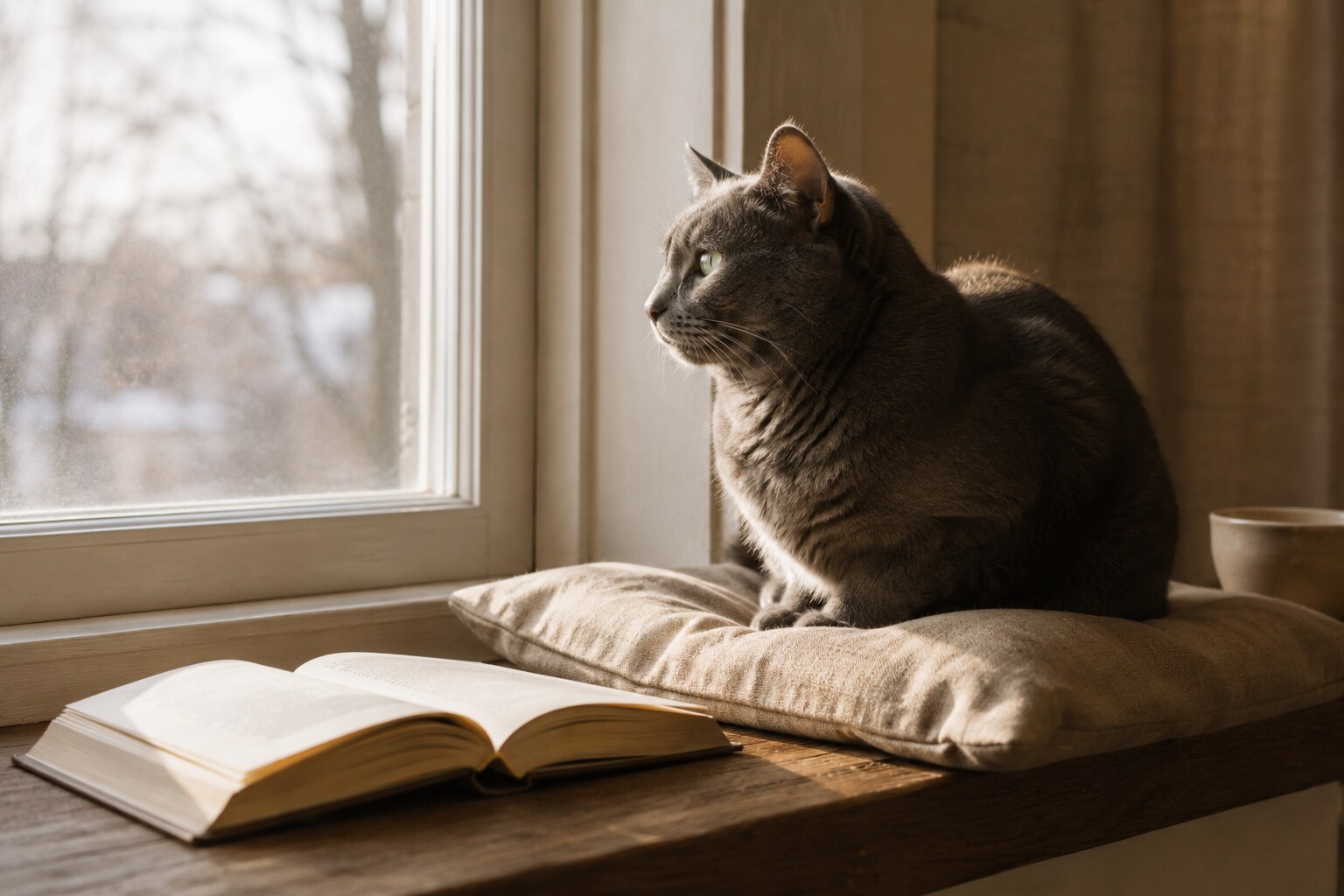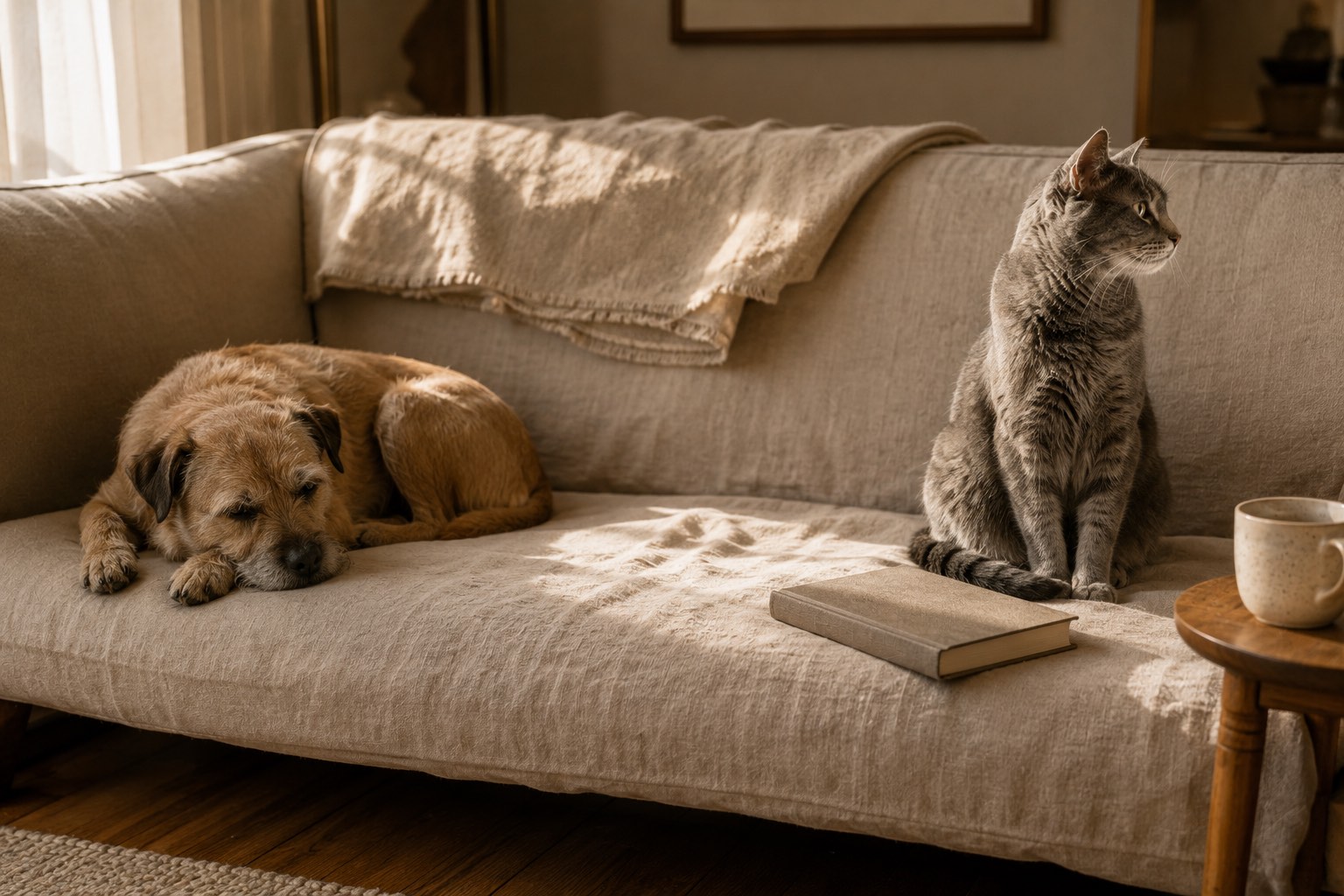
A book about more than one companion is a profile of a household, made of pages a pair (or trio) actually share. The cat-and-dog cohabitation that runs on its own quiet schedule. The two senior dogs at opposite ends of the same sofa. Editorial composition asks the writer and the photographer to read the household as a unit and to find the rhythm the animals themselves have already settled into.
Multi-pet households are common. Pew Research's 2023 ownership study found that 35% of US adults keep a dog and 28% keep a cat, with a meaningful share of households living with both. The decision a household with two or three companions actually faces, when it commissions a keepsake book, is structural before it is editorial.
The two structural options
A household composing a book about more than one pet chooses one of two structures, and the choice settles almost every editorial decision that follows.
The first option is the combined book. A single volume that profiles the household as a unit. The dog and the cat (or the two dogs, or the three cats) share the pages. The narrative threads them together. The photographs show them in the same rooms, on the same furniture, at the same hours.
The second option is the set. Separate volumes, one per animal, each a profile in its own right. The books sit on the shelf as a set. The household reads them one at a time. The narratives can run on their own timelines and reach their own conclusions.
Both options are valid editorial answers. The household's reading habit settles which one fits.
When the household reads as one
The combined book works when the animals share a household rhythm. The cat on the kitchen counter while the dog waits for the walk. The two senior dogs who sleep at opposite ends of the same sofa. The three cats who divide the house into territories and meet, briefly, in the windowsill at four in the afternoon. Households like these have a single internal weather. A combined book honors it.
The editorial register of a combined book reaches for relationship as much as character. The page that opens with the dog at the door at half past nine continues with the cat watching from the bookcase above. The scenes braid. A reader at the kitchen table reads the household in motion rather than two separate animals in stillness.
Combined books also work, plainly, for the gift buyer. A friend's household with three rescues, a couple celebrating their fifth year with the same two dogs, a family marking an adoption anniversary that includes a senior cat and a younger dog. The single bound object gives the gift a shape. (For the wider category context, see what is a personalized pet storybook.)
When the household reads as two
The set works when each animal has a markedly different relationship with the household. The dog who walks with one person and the cat who shares the desk with another. The two cats who joined the household at different times and have never resolved their truce. The older dog who has been the household's whole life for a decade and the new puppy who is a different book entirely.
A set lets each animal carry their own register. The older companion asks for a quieter voice and a contemplative palette. The puppy asks for a louder, glancing voice and a brighter palette. A combined volume struggles to hold both registers without one diluting the other.
The set is also the right choice for the household that wants to give each animal their own object on the shelf. Books, like animals, occupy space. Two thin volumes, side by side, read as a relationship between two specific lives. One thicker combined volume reads as a portrait of the household. Both are honest. The choice is what the household wants to see on the shelf in a year.
What the photograph asks of two
The photographic work for a multi-pet book sits one level above the work for a single-pet book. The household photographer is now reading the room for two patterns, sometimes overlapping, often not.
| Quality | Single companion | Two companions |
|---|---|---|
| Subject's attention | The pet's own world | The pair's shared geography |
| Frame logic | One animal as composition center | Two animals as composition rhythm |
| Best moments | Off-beat solo postures | Off-beat parallel postures |
| Light strategy | Whatever flatters the one animal | Whatever holds both faces in tone |
| Editing yield | Five strong frames per hundred | Two strong frames per hundred |
| Page sequencing | Solo scenes in rhythm | Solo scenes plus pair scenes in rhythm |
The yield difference is structural. A household photographing two animals catches each animal in a different moment of their own day, and the photographs the household actually wants are the ones in which both animals were present at the same instant, framed by the same room. Those moments arrive less often than the solo ones. The discipline is the same as in any documentary practice: more frames, more patience, the willingness to put the phone down and try again tomorrow. (For the underlying method, see photographing the pet you live with.)
A working rule that has settled at the Journal: every multi-pet keepsake book should hold at least three photographs in which both (or all) companions are in the same frame. Fewer than three and the book reads as two solo books that happen to share a binding. Three or more and the book reads as a profile of the household.
What the writing carries between them
The prose for a multi-pet book has a quieter problem to solve. Each animal needs their own voice on the page, and the household needs to be the through-line that holds the voices together. Mishandled, the writing becomes a list of solo paragraphs. Done with care, the writing reads as a household reading itself aloud.
A short working method:
- Name each animal at the top of every scene they appear in. The reader at the kitchen table needs the name as an anchor. The repetition is editorial, not redundant.
- Let each animal keep one habit per page that only they do. The dog who taps the door handle. The cat who waits for the spoon against the bowl. The habits ground the writing in specificity and stop the prose from blurring the animals together.
- Write the household first, the animals second, in any scene that involves both. The household at half past four on a Sunday afternoon is the frame. The dog asleep on the rug and the cat on the bookshelf above are the scene's two anchors. The frame stabilizes the writing.
- Reserve the parallel sentence for moments that earn it. The dog waits at the door; the cat watches from the windowsill. Used sparingly, the parallel honors the household's geometry. Used in every paragraph, the parallel becomes a tic and the prose becomes choreography rather than observation.
- Carry one quiet thread across the whole book. The shared kitchen, the morning ritual, the spot in the garden where both animals end up at the same hour. The thread is the household. The animals are the household's two ways of inhabiting it.
The writing rule for multi-pet keepsakes is the same rule that holds for any editorial work on a companion. The writer's job is to be specific enough that the household recognizes itself on the page. The specificity, in a multi-pet book, has to extend across two or three companions without flattening any of them. (For the wider editorial argument on tense and voice, see why we write pets in the present tense.)
The household is the through-line. The animals are the household's two ways of inhabiting it.
The household, on the page
A book about more than one companion, made well, reads as the household at its best. The pair sleeping at opposite ends of the same sofa. The cat watching the dog wait at the door. The three rescues sharing the kitchen floor at six in the morning. The book holds the small daily geometry the household sees and rarely thinks to record.
The decision between a combined volume and a set is the household's to make, and the editorial work follows from it. Heavy paper holds the photographs well in either form (see the case for the eighty-pound page for the material argument). The voice on the page stays steady across animals, and the rhythm of the book respects the rhythm of the room. The page is the household's record of the companions it lives with, in their own pairings, on their own time.