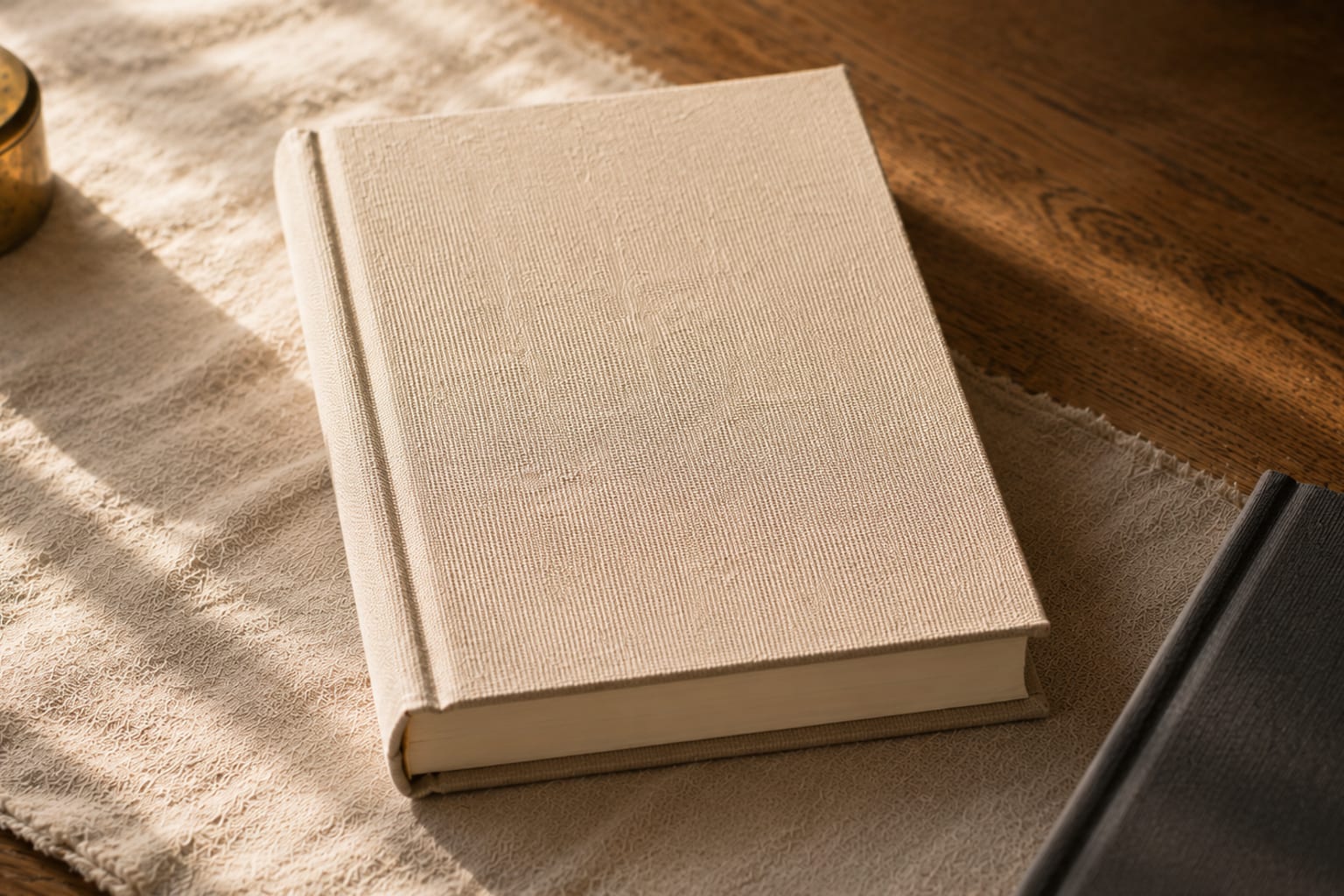
Paper weight is the first material decision in a printed book. Eighty-pound text paper sets the working floor for a book a household will keep. It holds a photograph without ghosting through to the next page, lies open without breaking the spine, and turns with the small satisfying weight that a thinner page cannot. It is the standard the Journal has settled on for keepsake editorial.
What "eighty-pound" actually means
The pound system for paper weight is older than it looks. Basis weight is the weight in pounds of 500 sheets of a given paper cut to the parent sheet size for its grade. The catch is that the parent sheet differs by grade. For text paper, used inside a book, the parent sheet is 25 by 38 inches. For cover paper, used for the outside, the parent sheet is 20 by 26 inches. Eighty-pound text and eighty-pound cover are different papers. One is the interior. The other is the jacket.
In the metric system, paper is measured in grammage (grams per square meter, gsm), and the conversion is cleaner. Eighty-pound text paper is roughly 120 gsm. Eighty-pound cover paper is roughly 216 gsm. Most household-grade print-on-demand defaults to 60 lb text (about 90 gsm), with some printers offering a 70 lb (about 105 gsm) upgrade.
A short comparison of the grades commonly available to small-edition printing:
| Grade | US basis weight | GSM | Typical use |
|---|---|---|---|
| 60 lb text | 60 lb | 90 gsm | Mass-market paperback interior |
| 70 lb text | 70 lb | 105 gsm | Standard print-on-demand interior |
| 80 lb text | 80 lb | 120 gsm | Editorial book interior, illustrated books |
| 100 lb text | 100 lb | 148 gsm | Art books and museum catalogs |
| 80 lb cover | 80 lb | 216 gsm | Softcover book covers, casewrap interior boards |
The household reader rarely encounters the pound figure, and never sees it on the finished object. The household reader feels the difference in the hand, on the first turn of the first page, before any of the words have been read.
Why a heavier page reads differently
A photograph printed on 60 lb stock leaks through to the page behind it. The household reader sees a faint shadow of the dog on page 7 while reading page 6, and the page on which the dog sits begins to feel less like a photograph and more like a transparency. This effect is called show-through in the trade, and it is the single most common reason a household will quietly decide a book is cheap.
Eighty-pound paper, at 120 gsm, has the opacity to carry a photograph without ghosting. The page reads clean. The image on the page sits on the page, with no faint second image leaking through from behind. The reader's attention stays where it should stay, on the dog or cat in front of them, undivided.
There is a second physical quality the heavier page changes. Heavier paper turns more slowly, with more presence in the hand. Lighter paper flips. Heavier paper turns. The difference is the same difference between a hardcover novel and a supermarket paperback. The reader's body knows the distinction within the first three pages of any book they pick up. The editorial keepsake is built to be the first kind.
A third quality. Heavier paper is more opaque. A dense sheet stops the image on the reverse from ghosting through, so a full-bleed photograph on one page does not haunt the text on the next. The images the Journal builds with rely on this. A clean image at the source, printed on stock heavy enough to keep its neighbor out of the way, reads on the page as a photograph. The same image on 60 lb paper reads as a copy of a photograph.
Lighter paper flips. Heavier paper turns.
The economics of the cheap page
Most print-on-demand books default to 60 lb paper for a simple reason. The lighter stock is cheaper per sheet, lighter to ship, and lets the printer offer a low headline price. For a paperback novel meant to be read once and recycled, this is the right tradeoff. The book has a few hours of reading life, and the page weight is invisible inside the reading experience.
For a book a household keeps, the math inverts. The book will be opened several hundred times across the decade after the book ships, by the household and by anyone who comes through the kitchen and notices it on the shelf. Each opening of a 60 lb book is a small disappointment the household stops being able to name after a while. Each opening of an 80 lb book is a small reassurance that this object was made with care.
The cost difference at the small-edition tier is real but modest. Eighty-pound paper raises the unit cost of a single book by a few dollars over 60 lb stock. For a book in the print-craft tier (see what is a personalized pet storybook for the price-tier reading), that few-dollar difference is the floor on which everything else stands.
How the page holds a photograph
A keepsake book is, in large part, a vessel for photographs. The photographs do the load-bearing work; the prose accompanies. (See photographing the pet you live with for the photographic argument, and why we write pets in the present tense for the editorial argument on the prose.) The page is what holds the photograph between covers, and the page's qualities decide how the photograph reads.
A photograph asks two things of the page beneath it: faithful color, and enough body that the page feels like a book. Coating answers the first. A coated sheet holds ink at the surface, so detail stays sharp and color stays true — the coat of a tabby reads in individual hairs rather than a soft blur. This is why photographic books have been printed on coated stock for a century.
Weight answers the second. The same coated sheet at a light weight feels like a catalog page: bright, thin, disposable. At eighty pounds it feels like a plate in a monograph. What separates catalog from keepsake is the body of the page, and eighty-pound coated stock holds an image at the right register for a book meant to be read aloud at a kitchen table for years.
The Library of Congress preservation guidance on paper notes that paper with adequate weight, neutral pH, and minimal lignin content holds image and text reproduction over decades of household storage. The household keepsake is built to outlast its first reading by a long way. The page weight is the first contributor to that lifespan.
A working guide to paper for keepsake books
A short summary of the choices that have settled at the Journal, for households making a keepsake book in the next year, or printers commissioned to produce one:
- Choose 80 lb text minimum for the interior. Lighter stock is acceptable for a casual gift. For a book the household intends to keep, 80 lb is the floor.
- Choose coated stock for photographic interiors. Coating keeps detail sharp and color true. Pair it with real weight: a coated page at eighty pounds reads as a plate in a book, where the same coating on a light sheet reads as a catalog.
- Match cover weight to binding. A softcover keepsake wants an 80 lb cover at minimum. A casewrap hardcover wants the boards and endpapers that match the editorial tier inside. (See a short history of the casewrap cover for the binding choice that pairs with this weight of interior paper.)
- Verify opacity before approving a proof. A printer's paper sample book should show the back of a page held up to light. If the printed text on the reverse reads clearly through the page, the stock is too light for editorial work.
- Ask the printer for the gsm figure, not only the basis weight. The international standard is cleaner. Eighty-pound text on a US printer is the same paper as 120 gsm on an EU printer. Comparing by gsm avoids confusion across the two number systems.
- Order the proof. Always. The hand and the eye decide what the spec sheet cannot. A printed proof of a single spread tells the household more about the finished object than any quoted paper weight.
These six rules produce the print-craft tier from the inside out. The household photographer can do every other thing right; the page is the floor.
A note on shelving life
Pew Research's 2023 study on pet ownership found that 51% of US pet owners consider their pet to be as much a part of the family as a human family member. The keepsake book takes that finding as a working brief. A book about a member of the family is a book that belongs on the shelf with the other books that hold the household's history. It will be moved between rooms, set on the kitchen table, lent to a friend whose dog has just settled into their home, opened again on a quiet Sunday afternoon a decade after it was made.
A heavier page is the first thing that lets the book do all of that. The book that fails the third reading does not earn the place on the shelf, regardless of what the cover says.
The eighty-pound page is, in the end, a small material claim. The book is heavier in the hand than the household expected. The photograph on the page is clearer than the household had hoped. The page turns with a quiet weight the household notices on the first reading and stops noticing by the tenth, because by then the page has done its quiet work. This is the floor the Journal builds on. Everything else, the prose, the photograph selection, the binding, the cover treatment, rests on it.