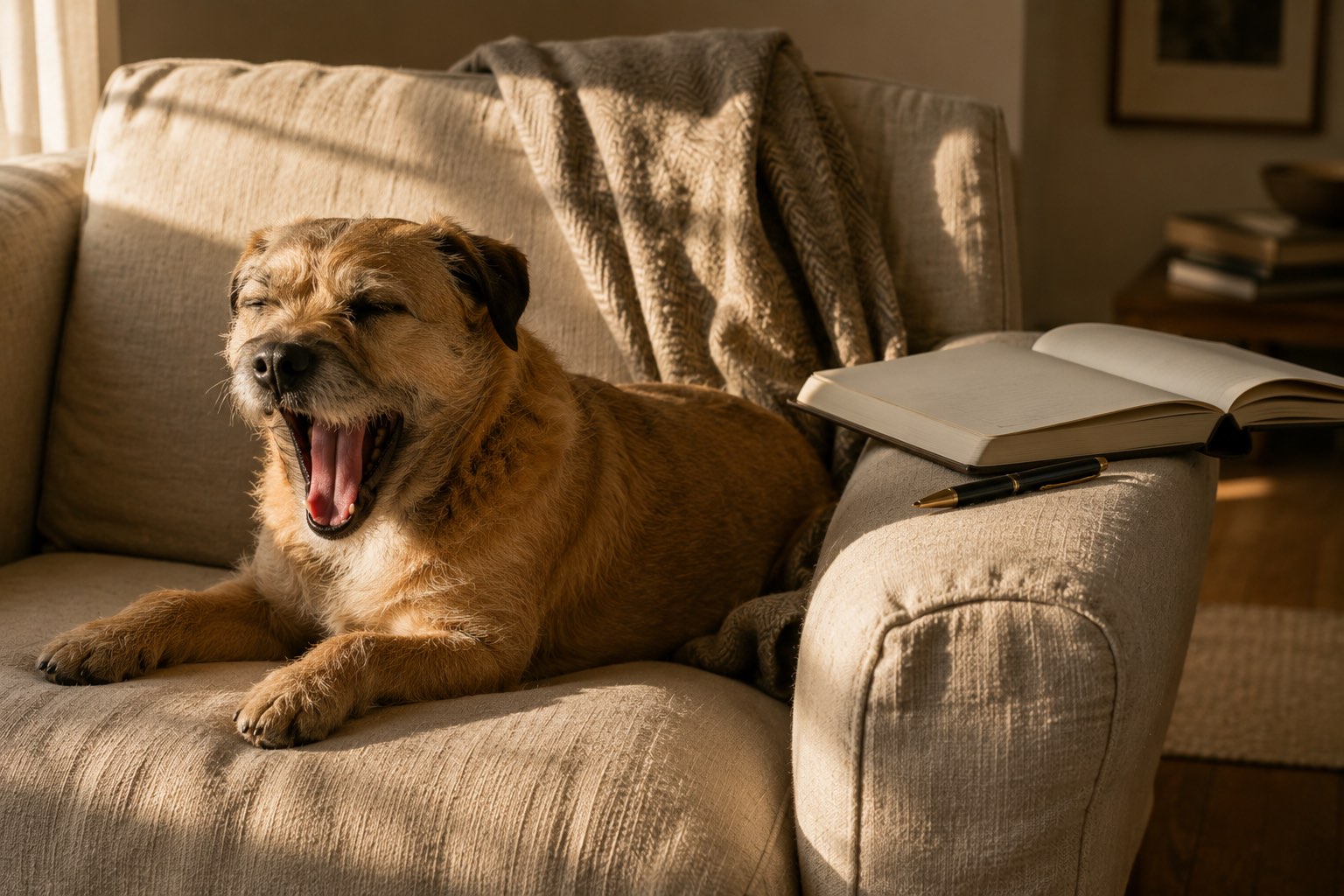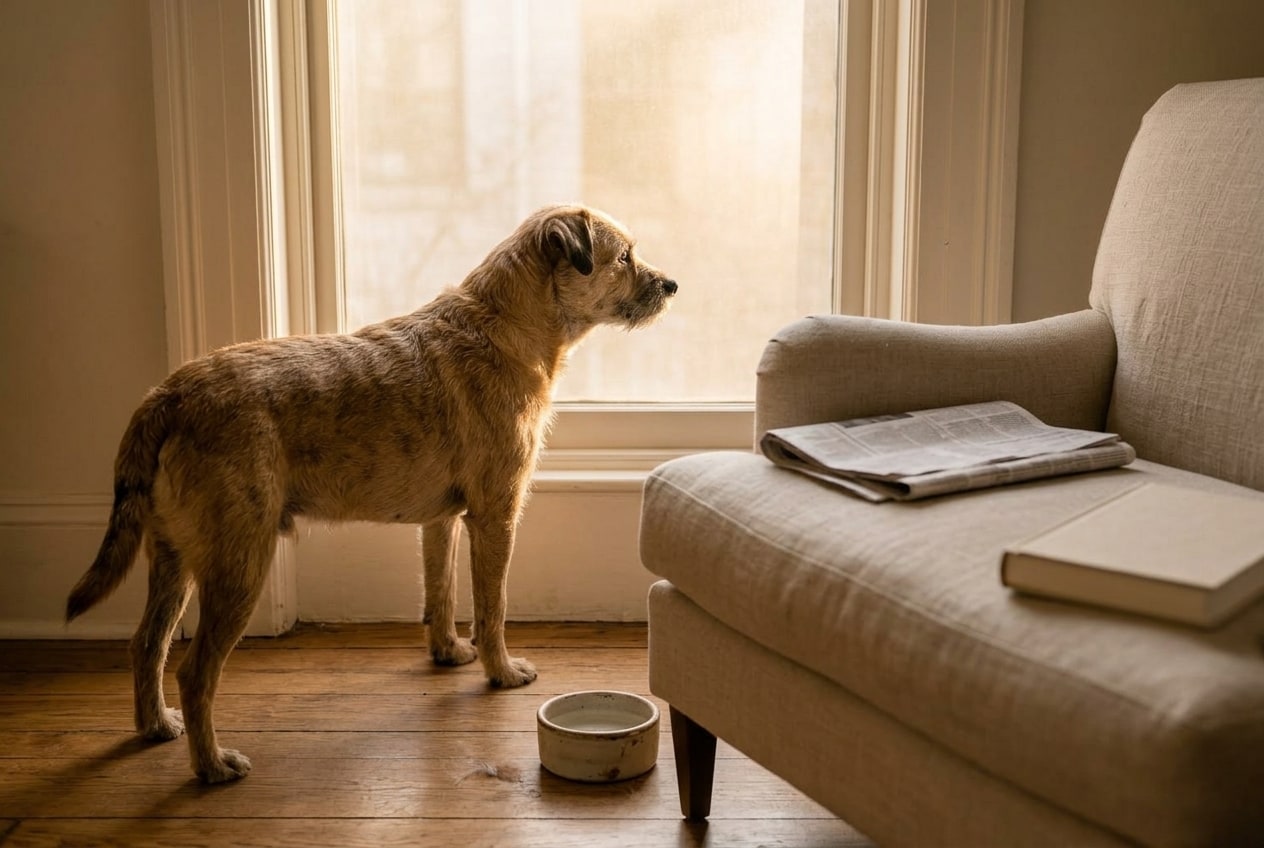
Writing a pet as a character is the practice of composing prose so that a specific animal shows up on the page as themselves. The particular dog, the particular cat, with observable habits and a private history the household would recognize. This is the load-bearing editorial discipline of any keepsake worth keeping, and the difference between a book a household reads once and a book a household reads for a decade.
What "writing a pet as a character" means
The phrase is at once ordinary and technically loaded. Every household with a pet already treats their dog or cat as a character in the household story: names, jokes, running observations across years. The editorial question is what happens when that character has to move from the kitchen table onto a printed page and hold up in the register of a book.
A page treats a pet as a character when the reader who has never met the animal comes away with a sense of a specific being in a specific room. That reader can describe the pet back in three or four particulars a stranger would not have invented. Character writing is what closes the distance between the household that knows the dog and the reader who does not.
A page treats a pet as a caption when it identifies rather than acquaints. The pet is named, breed and age are given, one or two photograph-adjacent facts are noted, and the page moves on. Captions do their own work and belong in books; see the difference between a character and a caption for the argument on where the caption is the right instrument. Character work is the register the body of a keepsake asks for.
The pillar takes the position that character writing is a specific set of craft moves rather than a mood. The moves can be named, practiced, and edited toward. The rest of this piece is the working set.
Why the household needs the character
A household commissioning a keepsake already knows their pet completely, in the way one member of a household knows another. The book cannot tell the household anything factual about the dog they do not already know. The book's job is a smaller, harder one: to write down what the household has always felt, and to write it in language the household can hand to a friend, a niece, an evening's stranger.
Pet-keeping in the US is now family-scale. A 2023 Pew Research Center study found that 51% of US pet owners consider their pet as much a part of the family as a human member. Households that describe their companion in the register of family expect the book to sit at family register. A profile of a person you love is written with the same instrument as a profile of a pet you love. Character writing is that instrument.
The literary tradition supports this instinct. Virginia Woolf's Flush (1933) treated Elizabeth Barrett Browning's spaniel as a character with a point of view. James Herriot spent decades composing veterinary essays in which specific dogs, cows, and cats arrived as recognizable characters in a working country practice. John Grogan's Marley & Me (2005) reached a wide readership on the strength of one very particular Labrador retriever. The audience for a book that takes an animal seriously has existed for a long time, and the market has followed.
The Journal takes the position that a household keepsake belongs on the same shelf, at a household scale.
The three traps of pet character writing
Three particular difficulties recur in keepsake drafts, and naming them helps a writer avoid them.
The mind-reading trap. The temptation is to attribute interior monologue to the pet: she is thinking of the biscuit, he decided to forgive us. The prose sounds intimate and is, technically, fiction. The character on the page becomes the writer's projection rather than the animal the household lives with. The corrective is behavior first, and inference held to a minimum.
The species trap. The temptation is to lean on breed characteristics or species generalities: golden retrievers are loyal, cats are independent. These sentences are true of an aggregate and useless about a particular. They also read as internet-encyclopedia prose, which is exactly the register a keepsake should avoid. The corrective is specificity to a single animal in a single household.
The saccharine trap. The temptation is to reach for the settled vocabulary the pet-writing industry has calibrated for greeting cards: unconditional love, forever friend, the sweetest soul. Every one of these phrases has been rendered so worn by repetition that they no longer land on a reader. The corrective is the household's own vocabulary, edited down to phrases that would only ever be spoken about this animal.
The three traps each pull toward the same failure: a page that could have been written about any pet by any writer, and consequently belongs to no household in particular. Character writing is the discipline that keeps a page anchored to one specific animal.
The craft moves
The moves that produce character writing are teachable. A working set of seven:
- Habit over trait. A pet's habits are specific, observable, and unique to a household. Traits are aggregate and generic. Write the habit; the trait shows through it. Loyal is a trait; walks the length of the back garden fence every morning before eating is a habit. The reader learns the trait from the habit without being told.
- Object over adjective. A pet's character often compresses into a small, particular object. The second piece of toast. The favorite blanket. The corner of the sofa that has become their corner. A single object, described precisely, carries more character than three adjectives about temperament.
- Present tense for character, past tense for events. Character on the page stays present because the household's relationship with the animal stays present. Events with beginnings and ends move to past tense. See why we write pets in the present tense for the editorial argument on tense in keepsake writing; the working rule is character present, event past.
- Observed behavior over inferred motive. Write what the animal does, and let the reader draw the inference. He waits at the door at half past three is behavior. He waits at the door at half past three because he loves us and misses us is inference bolted onto behavior. The behavior alone carries the emotional weight; the inference weakens it.
- Show the household through the animal. A dog waits for someone in particular, in a particular chair, at a particular hour. Every one of those particulars is the household. Character writing is a household portrait in which the pet is the visible subject, and the household is the shape the subject moves through.
- Write in the household's actual vocabulary. Nicknames. Kitchen jokes. The small verbal habits a household has built around one specific animal. Editorial polish comes later; the household's own vocabulary is the source.
- Prefer the small honest sentence over the large decorative one. A short observation, precisely worded, is warmer than a long paragraph reaching for cadence. Compression is the friend of character prose.
These seven moves are the working substance of the craft. Each of them is a discipline against one of the failure modes above.
Character versus adjacent forms
A working comparison. Writers new to the register sometimes reach for the shape of an adjacent form; naming the shape helps a writer stay on the keepsake side of the line.
| Form | What it does | Where it fits |
|---|---|---|
| Portrait | A single visual image of the pet; a caption or short paragraph accompanying it | The framed print above the mantel; the endpaper of a book |
| Caption | Identifies the pet, place, or moment in fewer than a dozen words | Cutlines under a photograph; the table of contents; the credits page |
| Species profile | Describes the breed, temperament, or care needs at aggregate level | Encyclopedia entries, adoption listings, veterinary reference |
| Household anecdote | A remembered story about the pet, usually short and told aloud | The dinner table; a friend's visit; a text to a family member |
| Character prose (keepsake) | Composes a specific animal on the page from observed particulars, in a voice the household will recognize | The body pages of a keepsake book |
Each form is honest and useful in its place. The keepsake book fails when it borrows the shape of an adjacent form (usually caption or species profile) and prices it at keepsake tier. Character prose is a distinct form with its own moves.
The interior question: how much of the animal belongs on the page?
The oldest question in animal writing is how far the writer can go inside the animal's mind before the writing becomes fiction about a human's projection rather than nonfiction about a specific creature.
The Journal's working position is that the writer stays outside the animal's head. What can be observed goes on the page. What must be attributed stays in the household's private register, where it belongs. The dog waits at the door; the writer records the waiting. Whether the dog is thinking about biscuits, or listening for the postman, or simply doing what he has always done at that hour, is unknowable, and the honest editorial choice is to leave the unknowable unclaimed.
Restraint about the animal's interior is a form of respect. A page that describes a companion accurately, without narrating their thoughts, gives the reader room to see the specific being in the room. The household already knows what the animal is thinking. The reader is trusted to sit with the animal and draw their own conclusion.
The best pet writing in the literary tradition works this way. Herriot's dogs are what Herriot saw. Woolf's Flush keeps most of its interior in the shape of the world Flush encounters rather than the words Flush thinks. The keepsake tradition, at its best, sits inside the same discipline.
Voice and register: household inside editorial
A keepsake at Pets & Pages is edited into two registers alongside each other. The first is the household register, the voice a household uses about their own animal at the kitchen table. The second is the editorial register, the cadence a book uses because a book will be read by someone who is not sitting at the household's kitchen table.
The household register is the source. Without it, the book sounds like it could have been written by anyone about any pet. The editorial register is the shape. Without it, the household's private material would fail to carry across the table to a reader who did not grow up in the household.
The editor's work is holding both registers alive at the same time, sentence by sentence. The household's vocabulary supplies the phrases. The editorial cadence supplies the pacing that lets the phrases land. When the balance is right, the reader hears a specific household talking about a specific animal in a book that has been carefully composed.
The tension between the two registers is the daily craft. A page that goes fully into household register reads as inside-baseball. A page that goes fully into editorial register loses the specific animal in the polish. The working tension is where a good keepsake lives.
Every household's pet is already a character. The writer's job is to notice, and to write it down carefully.
A short glossary
Character (in keepsake writing) The way a specific animal shows up on the page: observable habits, particular objects, and household context, composed so a reader who has never met the animal recognizes them.
Caption A short identifying line that names the animal, the place, or the moment. Captions belong to photograph cutlines and the credits page.
Household register The voice a household uses about their own animal at the kitchen table. Warm, specific, often quietly funny. The source material of character writing.
Editorial register The cadence a book uses because it will be read by readers outside the household. Ordered, unhurried, disciplined. The shape a keepsake takes.
Anthropomorphism Attributing human thought or emotion to an animal, usually in a way the observer cannot verify. Distinct from characterization, which uses observable behavior. Keepsake prose leans toward characterization and holds anthropomorphism at arm's length.
Specificity The load-bearing quality of character writing. Naming particulars rather than aggregates: this dog, this hour, this door, this piece of toast.
The test
The working test the Journal uses on any keepsake page is simple: read the page aloud to someone who has never met the animal. If the listener can, after one hearing, describe the pet back to you in three particulars a stranger would not have invented, the page is doing character work. If the listener can only repeat the animal's name and breed, the page is caption work in editorial clothing. See the difference between a character and a caption for the extended argument on this test, and photographing the pet you live with for the photographic version of the same discipline.
The test is deliberately simple. Character writing either survives the aloud reading or it does not. There is no way to fake the outcome after the fact, which is why the test is worth keeping.
Where character writing sits inside the whole book
A keepsake book is composed of many parts: cover, endpapers, title page, dedication, opening spread, body pages, closing reflection, colophon. Character writing lives in the body pages. The cover and endpapers are design work. The dedication is household register in short form. The colophon is bibliographic.
The pages between the dedication and the colophon are where a household lives with the book across years. Those pages have to carry the character across the reading life of the book. The material of the book helps: heavy paper, considered binding, a cover that lies flat. (See the case for the eighty-pound page for the material argument.) The prose is what carries the household forward through the years the book is read aloud. For the wider category context of the book itself, see what a personalized pet storybook is.
The character is the reason the household keeps the book. The material is the reason the book survives being kept.
A last word
The dog you live with is already a character. The cat asleep in the corner of the sofa is already a character. The character is already there before the writer sits down; the writer's job is to notice, and to write down carefully enough that a reader outside the household can also see them.
Character writing is the work that makes a keepsake a keepsake. It separates a book worth keeping from a book that sits on a shelf unopened. Every craft rule the Journal publishes about writing companions (see why we write pets in the present tense and the difference between a character and a caption) sits under this umbrella. The goal is always the same: put the specific animal on the page in a way the household will recognize and a reader outside the household will remember.
That is the whole discipline.