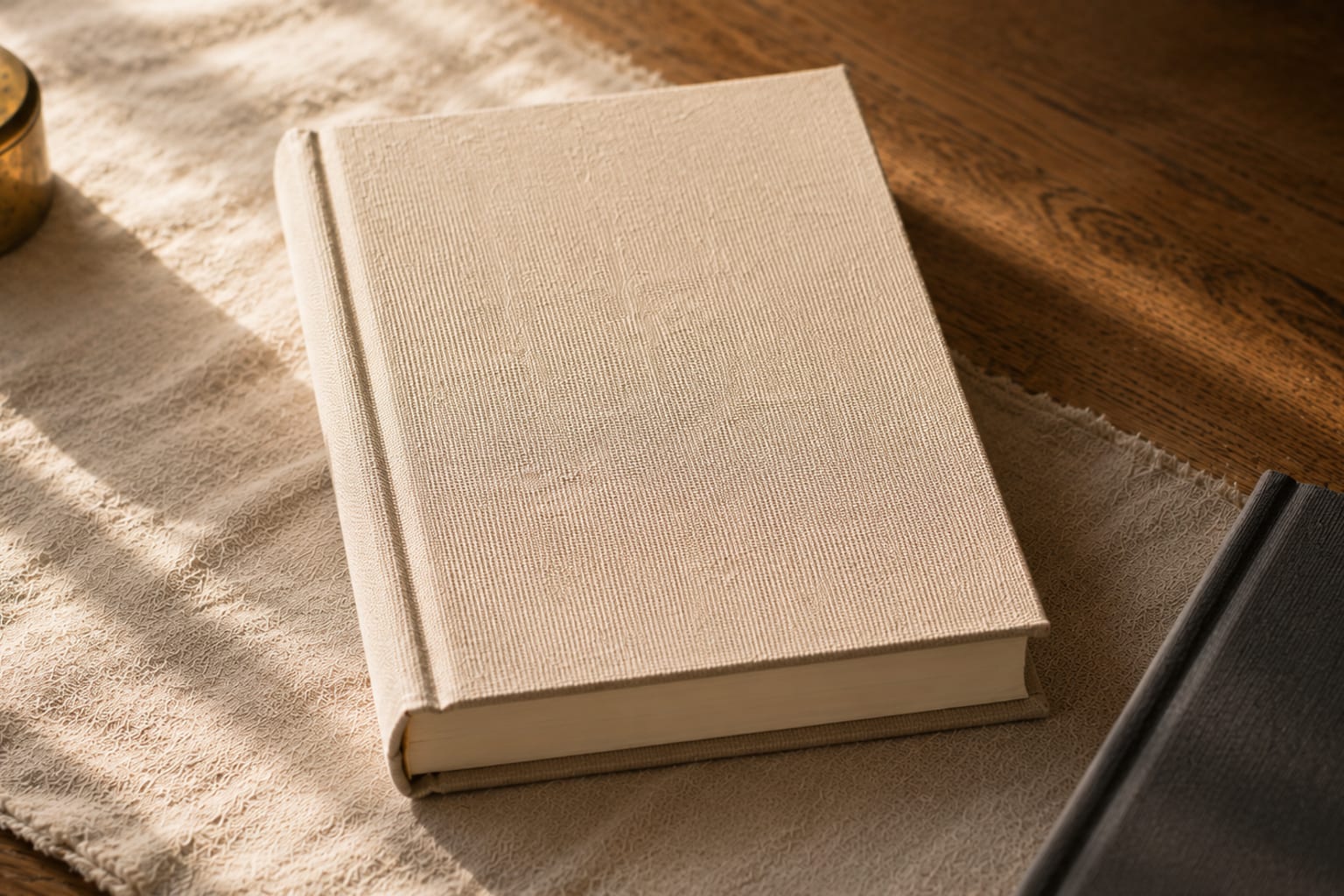
A casewrap cover is a hardcover binding in which a single piece of cloth or printed paper is wrapped directly over the boards of a book, with no separate dust jacket. It is the standard the print-craft tier has settled on for books built to last, and the form most household keepsake books are bound in today. Its quiet ubiquity is the result of a two-hundred-year argument about how a book should be made.
What a casewrap cover actually is
A casewrap is a particular configuration. Three boards (two for the front and back, one narrower piece for the spine) are joined by a single sheet of cloth or printed paper, the whole assembly glued to the text block by way of endpapers. The printed art lives on the boards themselves. There is no separate dust jacket sleeve to slip, tear, or lose to a coffee ring.
The other major hardcover formats handle the question differently. A traditional cloth-bound hardcover uses plain cloth boards (often a deep color, sometimes a debossed monogram) with a printed dust jacket layered over the top. A library binding adds reinforced hinges to survive repeated shelving cycles. A paperback dispenses with the boards entirely and glues a single piece of card stock to the spine. Each format trades one quality for another between durability, visual treatment, and unit cost.
A short comparison of the cover formats commonly available to small-edition printing:
| Format | Cover construction | Where the printed art lives | Typical use |
|---|---|---|---|
| Casewrap hardcover | Printed cloth or paper wrapped over rigid boards | On the boards themselves | Editorial keepsakes, art books, photo books, small-edition publishing |
| Cloth + dust jacket | Plain cloth over boards, printed jacket over cloth | On the removable jacket | Trade fiction and nonfiction, library hardcovers |
| Paperback (perfect bound) | Single piece of card stock glued to spine | On the card stock cover | Mass-market fiction, commodity print runs |
| Coil-bound | No board cover; spiral wire through punched pages | On front and back board pieces if present | Lay-flat workbooks, cookbooks, some children's titles |
| Saddle-stitched | Folded sheets stapled at the spine fold | On the outermost folded sheet | Pamphlets, thin photo zines, magazines |
The casewrap occupies the cell where printed art and a durable hardcover live in the same object. That cell is, structurally, why a household keepsake intended to be kept tends to end up in casewrap.
Where the casewrap came from
The story begins in early-nineteenth-century England. For most of the history of the printed book, hardcovers were leather, and the binding work was a hand craft performed by a specialist. A book arrived from the printer as a stack of folded sheets called signatures, and the household or library commissioned the binding separately. A book's exterior was a custom job, expensive enough that only well-off households owned bound volumes.
The British publisher William Pickering, working in London in the 1820s, is credited with the first edition-bound books in cloth covers. Pickering's Diamond Classics series, issued from 1821, came out of the workshop already bound, in modest cloth the publisher had specified. The innovation was less the cloth itself than the principle: the publisher bound the edition, and the household received a finished object.
The mechanical extension of Pickering's idea took until mid-century. The case binding, in which the cover is constructed separately from the text block and then glued on, came into widespread use across the 1830s and 1840s as the publishing trade industrialized. By the 1860s the case binding had become the standard form for trade hardcovers across English-language publishing, a position it has held with refinements for more than a hundred and sixty years.
The dust jacket arrived as a secondary innovation, beginning around 1820 as a plain paper wrapper to protect the cover during shipping. By the late nineteenth century the jacket carried printed art, and the cloth underneath returned to plain stock. The two-layer hardcover (plain cloth, printed jacket) became the dominant trade format for the twentieth century.
The casewrap, printed directly on the boards with no jacket, carried on as the form for books where the object was the point: art monographs, photo books, school yearbooks, fine-press editions. Its second flowering arrived with single-copy printing in the 2000s, which made small-edition casewrap economically feasible for the first time. Operations such as Lulu and Blurb brought the form within reach of a single household commissioning a single book.
Why the casewrap persists
Three properties keep the casewrap in continuous use across two centuries.
The first is durability. A casewrap has fewer moving parts than a jacketed hardcover. There is no separate jacket to slip, tear at the corners, or get bent on a shelf. The cover art is printed directly on cloth or paper that is then wrapped over boards and laminated, which protects the print from handling. A keepsake handled hundreds of times across a decade wears slowly and uniformly, with no patchwork wear pattern in the way a dust-jacketed book shows.
The second is presentation. The boards themselves carry the image. The book reads as a single composed object from the moment it is picked up, with no separation between the package and the contents. For a book whose subject is a specific dog or cat, this matters. The image of the household's pet is on the object that holds the book about the pet, with nothing between them.
The third is shelving behavior. A casewrap sits on a shelf with the spine bearing the title and the boards keeping their geometry. Repeated removal and replacement, the actual reading life of a household keepsake, leaves the corners and the cover surface largely as they were when the book arrived.
The cell where printed art and a durable cover live in the same object. That cell is the casewrap.
A casewrap on matched boards holds its geometry across twenty to forty years of household use. A jacketed cloth hardcover reaches similar numbers, with the jacket fading and tearing first. A paperback runs three to ten before the spine cracks. The casewrap is the engineering of a book a household opens repeatedly across decades.
The casewrap in a household keepsake
A printed pet storybook is a small object with a long reading life. The household opens the book on the day it arrives, on the day a friend visits and notices it on the shelf, on the morning after a senior dog has had a slower night. Each opening is a transaction with the cover and the spine fold. A book built for the thirtieth reading is built differently from a book built only for the first.
A heavy interior page, the eighty-pound text floor the Journal has settled on, asks for a binding that holds the weight without warping. The casewrap is the format that does that work. The boards stay rigid. The spine reinforcement holds the text block square. The image on the cover stays where the printer placed it.
The format choice also extends the editorial register the prose has established. A book whose subject is treated as a literary character, the way present-tense narration treats a companion, reads as an editorial object when bound in casewrap. The materials carry an argument about how the household intends to keep the book. Pew Research's 2023 study on pet ownership found that 51% of US pet owners consider their pet to be as much a part of the family as a human family member. A book about a member of the family belongs in the binding the other family books are kept in.
Cover portraiture composed for a casewrap is photographed slightly differently from work composed only for screen viewing. The photo selection question shifts when the image will live on the boards of an object the household will hold for thirty years.
For a household composing its first personalized pet storybook, casewrap is the default at the keepsake tier, and the recommended format for any book the household plans to read past the first weekend. The format makes the object's intention visible.
A working guide to choosing a casewrap cover
For households commissioning a keepsake book in casewrap, or printers being asked to produce one, the choices that have settled at the Journal:
- Print the cover art on the cloth or paper directly, not on a wrapper. A casewrap is defined by the printed-on-boards finish. A layered jacket is a different format with a shorter household lifespan.
- Specify a laminate over the print. An unprotected printed case scuffs at the first shelf contact. A gloss laminate deepens printed color and wipes clean — the right choice when the cover itself is a photograph — and it protects the print across decades of handling.
- Match the cover board weight to the interior page weight. A heavy interior on light boards warps over time. A consistent material specification across boards and pages is the floor of a casewrap that holds its geometry.
- Verify the spine reinforcement. A properly reinforced spine resists the box-warp that comes from years of shelving. Without it, the book begins to bow at the corners after the second year.
- Choose endpapers that match the interior register. Endpapers are the inside of the cover and the first page the reader sees on opening the book. A neutral cream endpaper carries the editorial register through the threshold.
- Order the cover proof. As with the interior pages, the hand decides what the spec sheet cannot. A printed proof of the cover, in the chosen laminate, on the specified boards, is the only reliable check that the object will read as the household intends.
These six rules produce a casewrap that earns its place on the shelf.
A note on shelving life
The Library of Congress preservation guidance on paper notes that the lifespan of a printed object in household storage depends as much on its binding integrity as on its interior stock. A casewrap with a properly reinforced spine, on matched-weight boards, with neutral-pH endpapers, will hold its geometry across decades of ordinary household use. The book moves between the shelf and the kitchen table and the spare room, and arrives in each new room as the book it was when it was made.
This is the unusual thing about the casewrap. The object was built by an industrial trade in early-nineteenth-century England for the case of small-edition trade publishing. Two hundred years later, with single-copy printing, the same form serves the case of a single household making a single book about a single companion. Two centuries of refinement have left the engineering settled. The format already works.