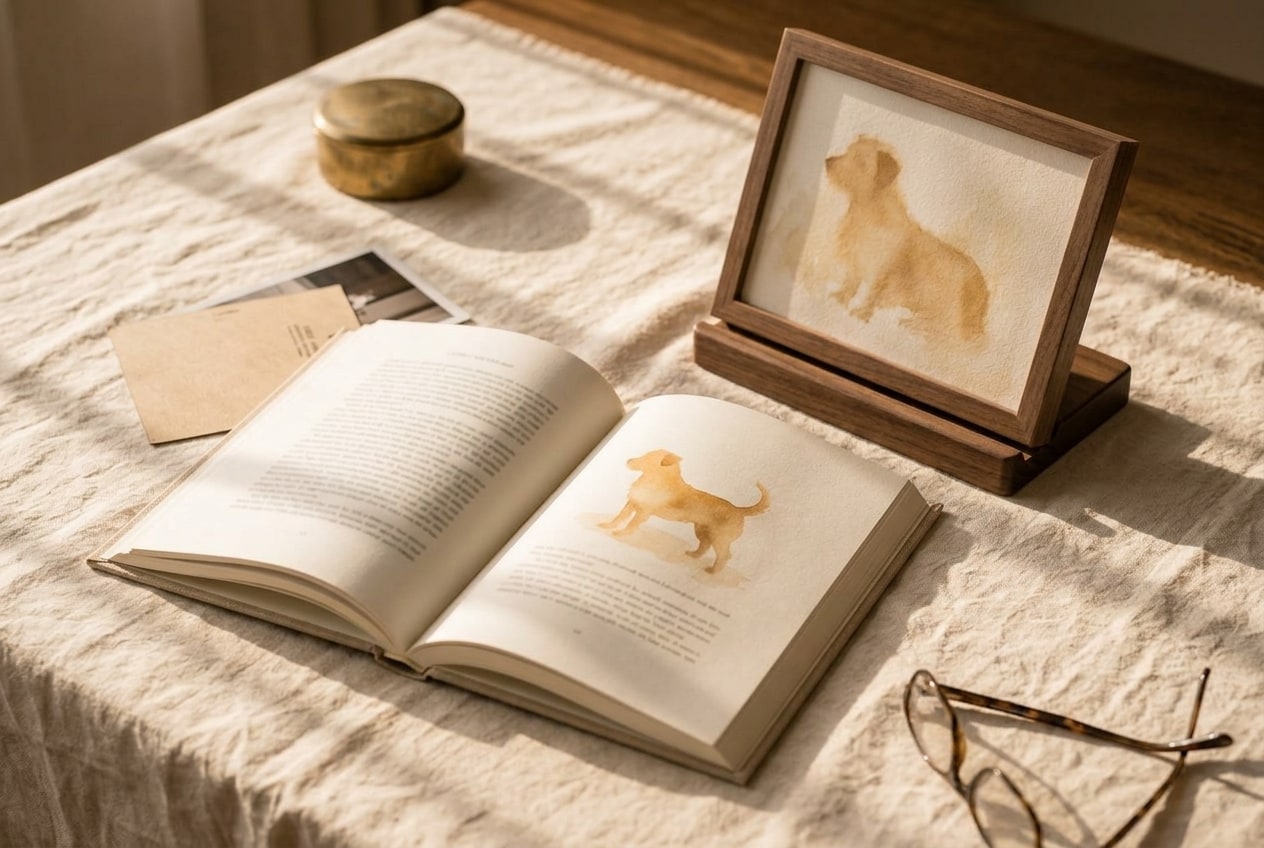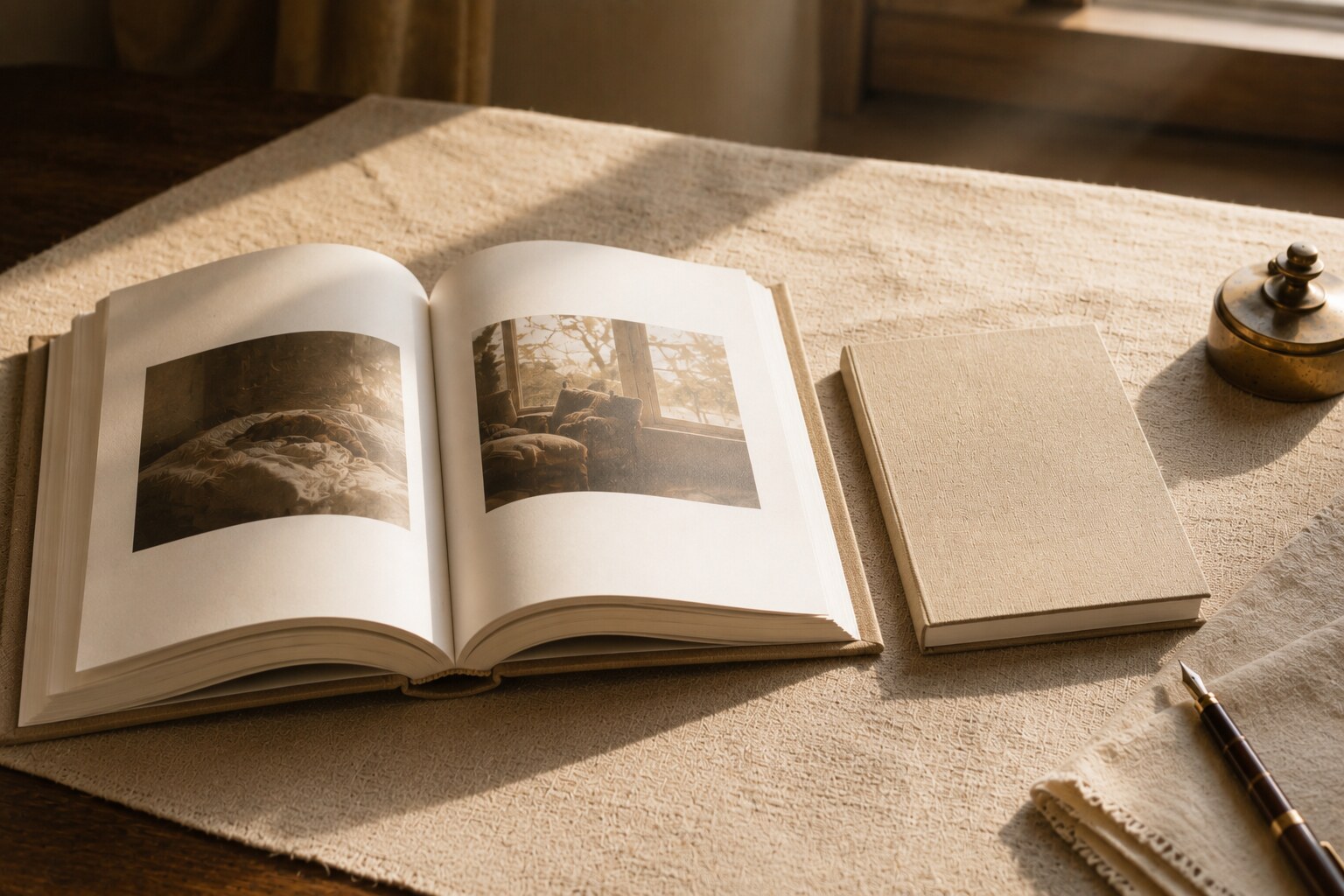
A personalized pet book for adult readers is a printed illustrated book that takes a specific household's dog or cat as its subject in the register of adult trade publishing: composed prose, considered scenes, materials a small press would commission, and a physical object built to sit on a shelf rather than in a toybox. The category exists as a distinct subgenre inside the broader personalized-pet-book market, and the difference is worth naming.
Where the category defaults to children
Personalized books, as a commercial format, grew up as a children's category. The modern wave dates to the 2014 launch of Wonderbly's Lost My Name, which turned personalization into a rhyme-shaped kids' picture book and sold more than four million copies. Almost every personalized-pet-book that followed inherited that shape: a rhyming or lightly-narrative story of 16 to 24 pages, cartoon or clip-art illustration, saturated palette, and a jacket built to catch the eye of a six-year-old on a bookshop shelf.
This is a real and useful book. Households with young children buy it for exactly the reader it was designed for. What the format assumes, though, is that the child is the reader and the pet is the accessory. Households buying a book about their own dog or cat, for themselves, arrive at the checkout page and find the same rhyming picture book waiting for them at a lower price point than they expected. The book is not wrong; the register is wrong.
The adult subgenre solves for the second household. The reader is a household of adults. The pet is the subject, treated with the specificity a magazine profile would give a person. The register is editorial rather than juvenile.
| Book aimed at | Register | Typical form |
|---|---|---|
| A six-year-old reader | Rhyming, playful, kid-narrative | 16-24 pages, cartoon illustration, saturated palette, softcover |
| An adult household | Composed prose, editorial cadence | 20-32 pages, lifelike illustration, muted palette, hardcover |
Both are personalized and printed. They are different products with different jobs, and the buyer's satisfaction hinges on picking the right one.
Who buys the adult version, and why
The adult-register buyer usually falls into one of three household shapes. The first is the household composing for itself: adult couples or singles who want a considered object about the dog or cat they live with. The second is the gift-giver buying for another adult household, often marking an adoption anniversary or a milestone the giver knows the recipient will hold quietly. The third is the household composing an in-life record of a companion whose habits the household wants written down while the details are still current.
All three buyers share a pattern in how they describe the pet. The Pew Research Center's 2023 pet ownership study found that 51% of pet owners describe their dog or cat as as much a part of the family as a human family member. The households that buy adult-register books are usually inside that 51%. They talk about the pet the way one adult talks about another. They want a book that talks that way too.
The gift-giving case is worth naming. A book at the adult register signals attention on the part of the giver. It says that the giver noticed the specific companion the recipient household kept, and chose an object considered enough to be kept. A rhyming children's book, given to an adult household as a serious gift about their dog, misfires in the same way a birthday card in crayon would.
What changes on the page
The writing craft argument is where the two registers separate most cleanly. A children's book about the family dog reaches for rhyme, exclamation, and dialogue that reads aloud well to a small child. An adult-register book about the same dog reaches for the sentences the household would speak to a friend at the kitchen table. The tense shifts. The vocabulary shifts. The unit of composition shifts from the couplet to the paragraph.
The Journal has written the tense argument at length. Writing pets in the present tense is the editorial default for adult keepsake work, because present tense is the tense a household uses at breakfast three years on. The other craft anchor is the difference between a character and a caption: a caption records that the dog existed, a character records the specific dog the household kept, and the character is what an adult reader wants on the page.
Adult-register prose in this category has three working properties. It is specific: it names the exact bark for the exact visitor. It is unrushed: the paragraph does the work the couplet cannot. And it is written for a reader who does not need the story explained. The reader is inside the household. The book knows.
What changes about the object
The material argument matters more at the adult register, because an adult reader is buying an object as much as a text. The case for the eighty-pound page sets the paper-weight floor. A book meant to be opened repeatedly over years needs the paper weight, the binding tolerance, and the cover treatment to survive being opened repeatedly. Adult-register books in this category are usually casewrap hardcovers on heavy stock, printed at native resolution rather than compressed for cost. They open flat where the reading requires it. They sit on a shelf between readings without warping.
The cover treatment is a giveaway. Children's-register personalizations lean on saturated cover art with the child's or pet's name printed large in a playful face. Adult-register books usually run a quieter cover: muted palette, restrained typography, one composed image or none, the way a small-press hardcover of an essayist's collected work would look on a shelf. The adult book is designed for the shelf it will live on.
Pets & Pages makes these books individually. They are printed to order, at heirloom tier, from a household's own photographs and notes. Every copy is a single copy for one household. The economics of single-copy printing are what make an adult-register personalized book feasible at all: a small press could not have produced a book of one twenty years ago at the price a household will now pay.
A short buyer's checklist
Households considering an adult-register book can settle the question quickly by looking for these six qualities in what they are about to buy.
- Prose, not rhyme. Read the sample text aloud. If it rhymes, it is a children's book. If it reads like a magazine profile of the pet, it is an adult book.
- Lifelike illustration, not cartoon. The scenes should look like photographs the household might have taken on a different afternoon. If the pet is rendered in a clip-art register, the book is aimed at a child.
- Hardcover, casewrap, heavy paper. The object is meant to sit on a shelf for twenty years. A stapled softcover on lightweight stock is aimed at a different reader.
- Muted cover, restrained typography. Adult-register covers borrow from small-press trade publishing, not from picture-book catalogs.
- Household-editable text. The final draft belongs to the people who lived the story. Look for a checkout flow that gives the household a preview and an edit pass.
- Adult length. Twenty to thirty-two pages of considered scenes reads adult. Sixteen pages of rhyme reads for a child.
A book that meets the six is composed for the adult reader. A book that meets one or two of them is a children's book with an adult sticker on the price tag. Household buyers in this category are usually paying a print-craft-tier price and are entitled to a print-craft-tier object; knowing the six qualities is how a buyer holds the seller to it.
A note on the two categories co-existing
The adult subgenre and the children's subgenre are not in competition. Households with young children still buy children's-register personalized books, and should; they were built for exactly that reading. Households buying for themselves, or for another adult household, are buying a different kind of book. The category is wide enough to hold both. What matters is that a buyer picking one book off the shelf gets the version they intended to buy. That is what naming the subgenre is for, and it is what the pillar essay on the category was written to clarify.