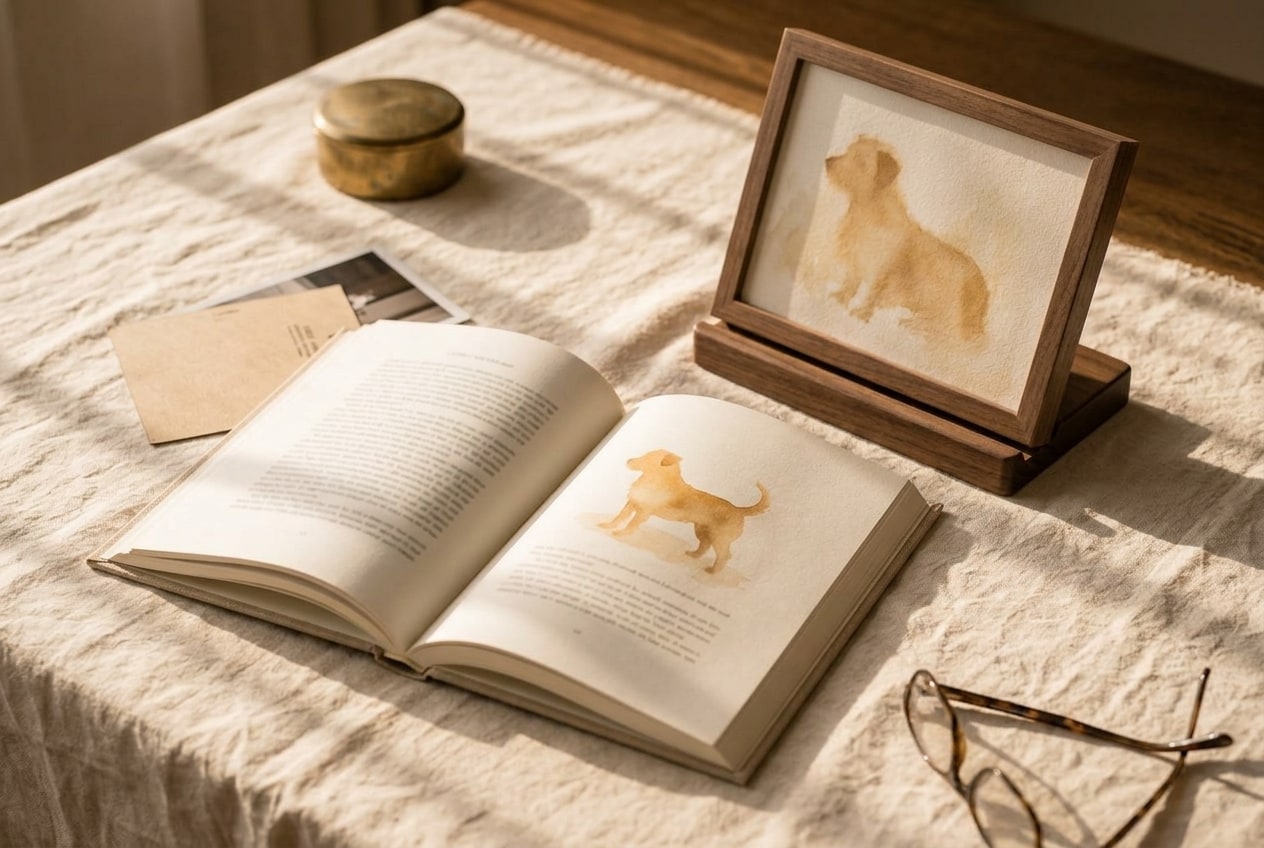
A personalized AI pet storybook and a commissioned pet portrait are adjacent purchases, often considered by the same household within the same afternoon. They are different objects. The book is a bound narrative the household reads aloud; the portrait is a single image the household lives with on a wall. Both honor a specific animal. Choosing between them is the household's question about how they want to keep the animal near.
What each object actually is
A commissioned pet portrait is a single illustrated or painted image of a specific animal, made by an artist working from photographs the household provides. Portraits arrive framed or unframed, in a medium chosen by the artist (oil, watercolor, ink, digital-with-print), and hang on a wall or lean on a shelf. The object is one image. The reading life is a glance repeated over years.
A personalized pet storybook is a bound illustrated book in which a specific animal is the main character, with prose, scenes, and a physical binding built from the household's own photographs and notes. Some are composed entirely by human writers and illustrators; a growing share are AI-composed with human editorial review. The object is a book. The reading life is an open one: pages turned, sections read aloud, a passage returned to over years. (See what is a personalized pet storybook for the full category walkthrough.)
The two categories look adjacent from the household's angle. They are different formats with different reading lives.
Why the household is choosing between these
Both categories serve a household culture that treats the animal as a family member. The American Veterinary Medical Association's 2024 pet ownership survey reports 66% of US households own a pet, and the American Pet Products Association's 2024 industry report puts US pet industry sales at $147 billion for 2023, roughly triple the 2010 figure. Portraits and personalized books both grew out of that shift. The household choosing between them has, in most cases, already decided that the animal deserves an object.
A quick comparison
The five-line summary most households need before going further:
| Commissioned portrait | AI-composed pet storybook | |
|---|---|---|
| Form | Single image, framed or shelved | Bound illustrated book, 20-40 pages |
| Duration of reading | A glance, many times over years | A sustained read, many times over years |
| Composition | One artist's hand and interpretation | Editorial narrative built from household photos and notes |
| Typical price tier | $80-$800 (widely variable by artist) | $30-$110 (editorial tier at $55-$110) |
| Timeline | 2-8 weeks, sometimes longer | 1-3 days for digital, 7-14 days for print |
| What the household holds | An image | An object with a narrative structure |
Both formats are valid. Most household disappointment in either category traces back to a mismatch: a buyer who wanted one object ended up with the other.
When the commissioned portrait is the right choice
The portrait is the right object for the household who wants a single, singular image of the animal, held in the register of the artist who made it. Portraits are objects of pigment and gesture. Their value is craft-particular. When the portrait is the right object, no other purchase substitutes for it.
The portrait fits the household who:
- Already has a wall or a shelf reserved for the object
- Wants a piece of visual art rather than a reading experience
- Values the specific hand and register of a chosen artist
- Is prepared to wait weeks and to pay accordingly
A portrait is the correct object for anyone whose relationship to the pet is expressed primarily through looking. It is also the right choice for someone commissioning an heirloom gift that will pass down as a work of art in its own right.
When the AI-composed pet storybook is the right choice
The storybook is the right object for the household who wants a reading practice. The book is opened at the kitchen table, kept on a shelf a household member reaches for on a rainy afternoon, read aloud to a child or to the room. Its value is in its length and its narrative: the specific dog, in a sequence of scenes, in words the household can read to each other.
The storybook fits the household who:
- Wants a book to open repeatedly, rather than an image to look at
- Wants the animal named as a character, with habits, a voice, a scene sequence (see the difference between a character and a caption)
- Wants an object that combines photographs, illustrations, and prose in one binding
- Is choosing a gift that will land as a thoughtful record rather than a piece of wall art
The book is also, functionally, an object that can be shared by several readers. A portrait hangs in one place; a book travels between rooms and between hands.
The overlap: households who want both
Some households want both objects for the same animal. The reasoning is not redundant. The portrait handles the visual register; the book handles the narrative register. A household choosing both is buying two different reading practices for the same subject.
The order tends to matter. Households that commission the portrait first often bring the portrait to the writing of the book, using the artist's interpretation as a visual anchor for the illustrations. Households that build the book first often use the printed illustrations to guide their choice of artist. Either order works. Neither is required.
Cost implications: buying both puts the household in a $200 to $1,000 range for a single animal, depending on tier. A household making this decision is worth asking directly what the two objects will do in the house, and where they will live.
Price tiers, honestly
Both categories are wide. The comparison is only useful with the tiers made explicit.
Commissioned portrait price tiers:
- Marketplace tier, $30 to $120. Digital portraits, some print-on-demand physical, delivered in one to three weeks. Quality is variable; the buyer is often paying for turnaround as much as for craft.
- Established independent artist, $150 to $500. A named artist with a portfolio, a waitlist, and a signature style. The buyer is paying for the artist's register and the physical object.
- Fine-art commission, $500 and up. An artist known for pet portraiture at gallery scale. Oil on canvas, months of work, occasionally into the low four figures.
AI-composed pet storybook price tiers:
- Cheap-and-fast AI tier, $8 to $25. Digital PDF or thin softcover, kid-register, generated quickly. Acceptable for a casual gift; rarely an object the household opens repeatedly.
- Mid-mass tier, $30 to $55. Hardcovers, more polished templates, illustration hiding the AI involvement. Solid for a holiday gift.
- Editorial print-craft tier, $55 to $110. Hardcovers on heavy paper, considered binding, adult register where it suits. The book is intended as an object the household keeps for years. (See the case for the eighty-pound page for the material argument on why the print tier matters.)
These tiers are not directly comparable. A $300 portrait and a $90 book do different work. The buyer looking at both should know the ranges before choosing.
The two household questions that settle it
Two questions cut through most of the confusion.
- When you picture the object in your house six months from now, is it on a wall or in your hands? If it is on a wall, you want the portrait. If it is in your hands, you want the book.
- Do you want a single image of the animal, or a sequence of scenes with prose? If a single image, portrait. If a sequence, book.
Households that answer "both" to either question are correctly identified as buyers for both objects, in whichever order fits their calendar and budget.
A note on the illustration question
A common concern is whether an AI-composed pet storybook can render the animal well enough to be an honest object of the animal's likeness. The honest answer is that the illustration tier of the book depends on the source photographs and the editorial care of the press composing it. A cheap-and-fast tier tends toward generic renderings; an editorial-tier press with human review can produce illustrations that read as recognizable and specific. (See photographing the pet you live with for the working method on choosing source photographs.)
The portrait, made by a chosen artist working from your photographs, will always be the higher-craft single image. The book, made carefully, will always be the more sustained reading experience. Neither category is trying to replace the other.
When neither is the right choice this month
Two conditions where a household should postpone the purchase.
The first: when the household has not yet taken good photographs of the animal doing ordinary things. Both formats depend on the photographic record. Portrait artists ask for reference photos. AI-composed books need photographs from multiple angles and moments. A household with only two or three phone snaps of the animal will be disappointed by either object.
The second: when the household is unsure whether they want a reading experience or an image. Neither format serves ambivalence well. A weekend spent identifying which of the two the household actually wants pays for itself in avoided regret.
A short guide, one paragraph
For the household who wants a single beautiful image of their pet on a wall, commission a portrait from an artist whose register you love, at the tier your budget supports. For the household who wants a book to read aloud, to open on a shelf, to place in a hand years from now, an AI-composed pet storybook at editorial tier is the right object, made by a press that treats the animal as a character. For the household who wants both, order matters less than making sure each object gets to do the work it does best.